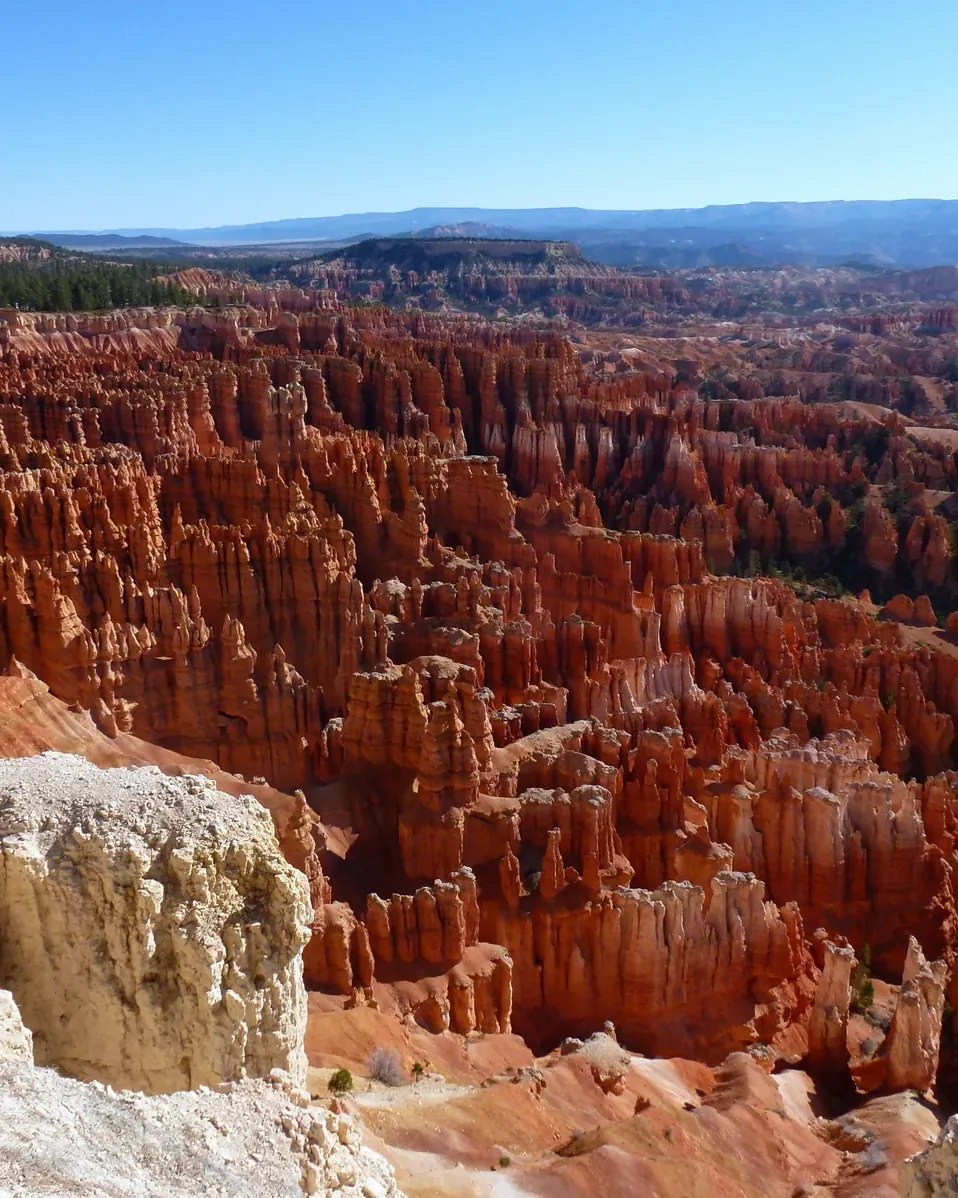
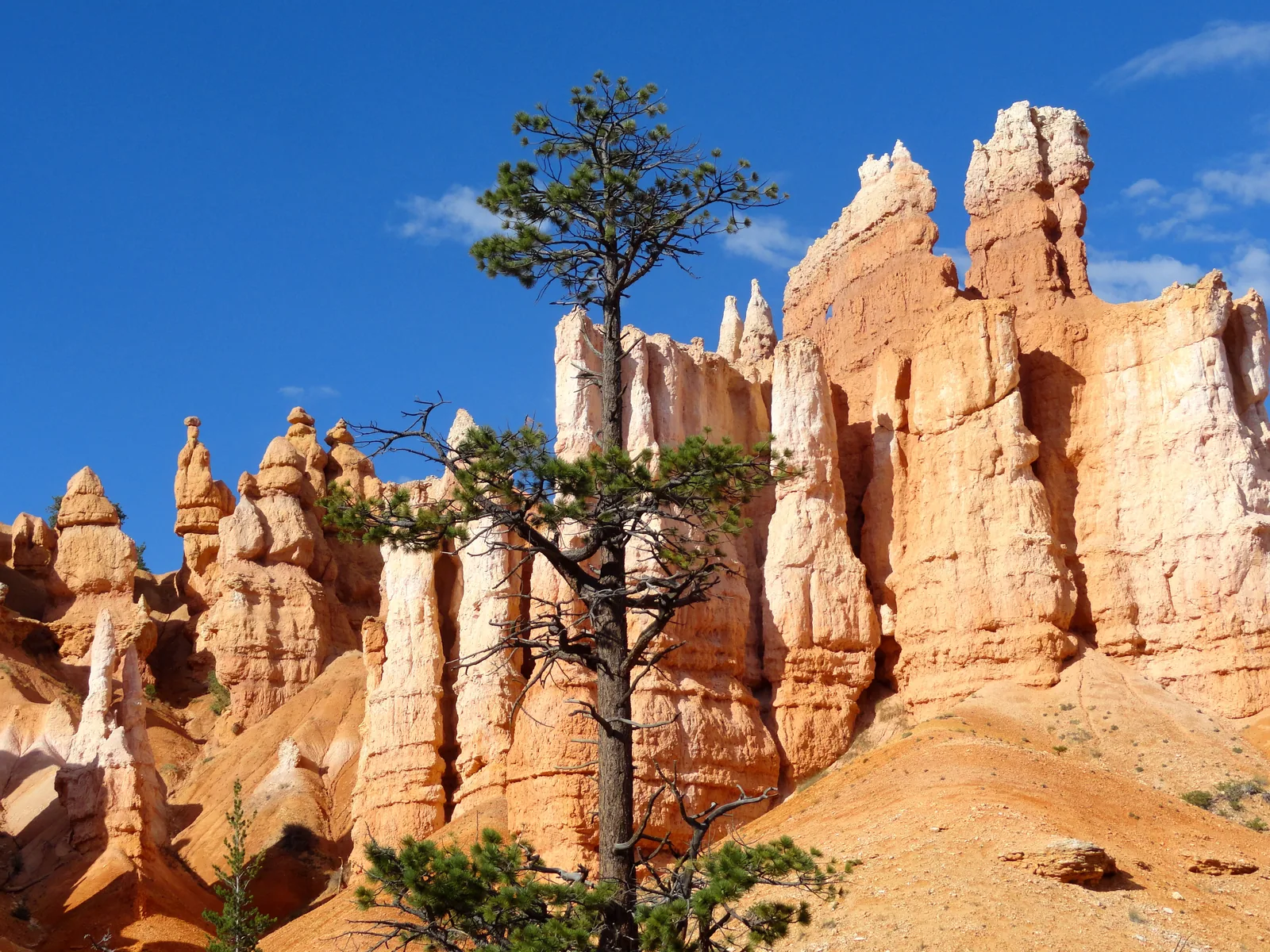
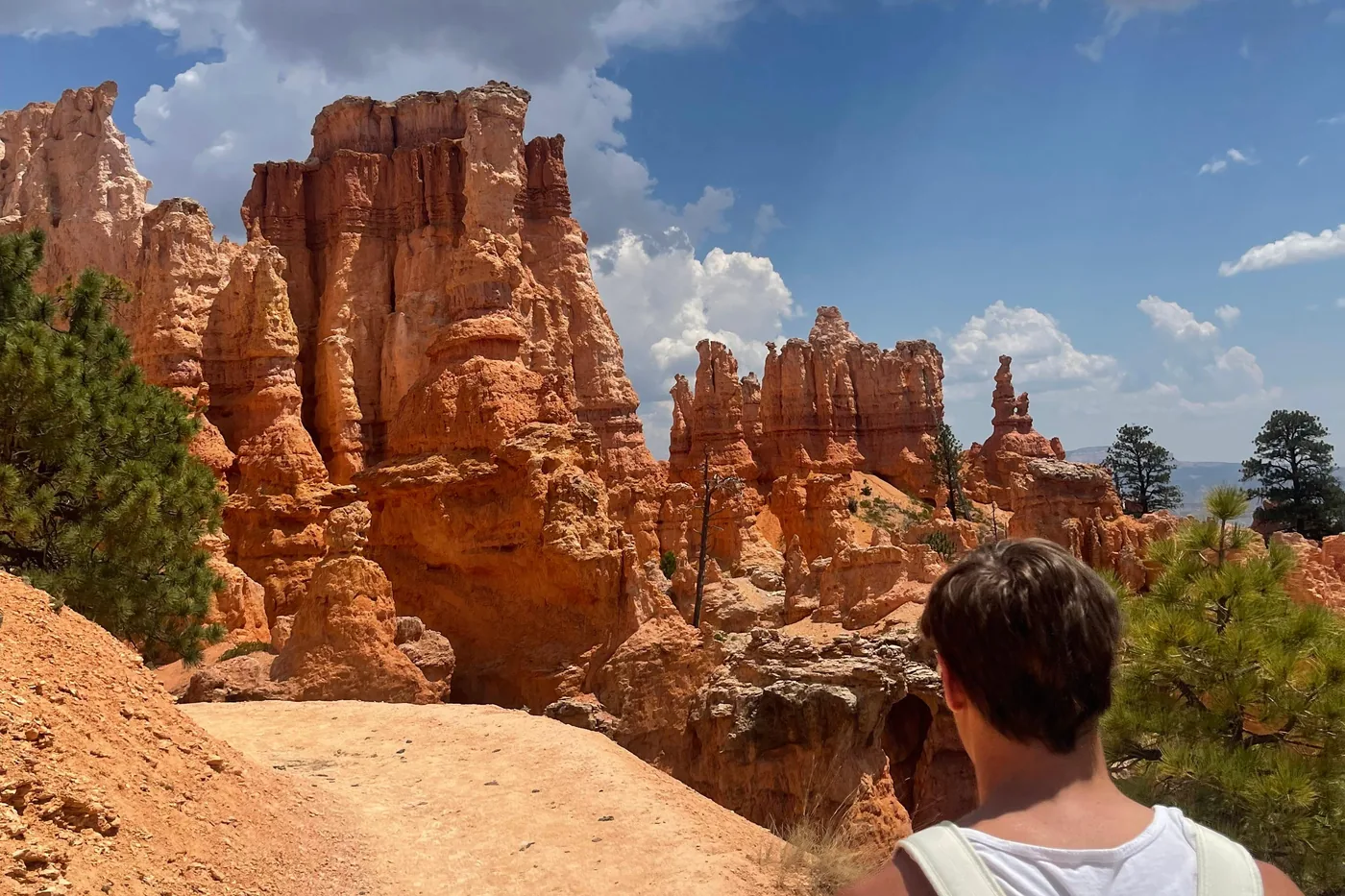
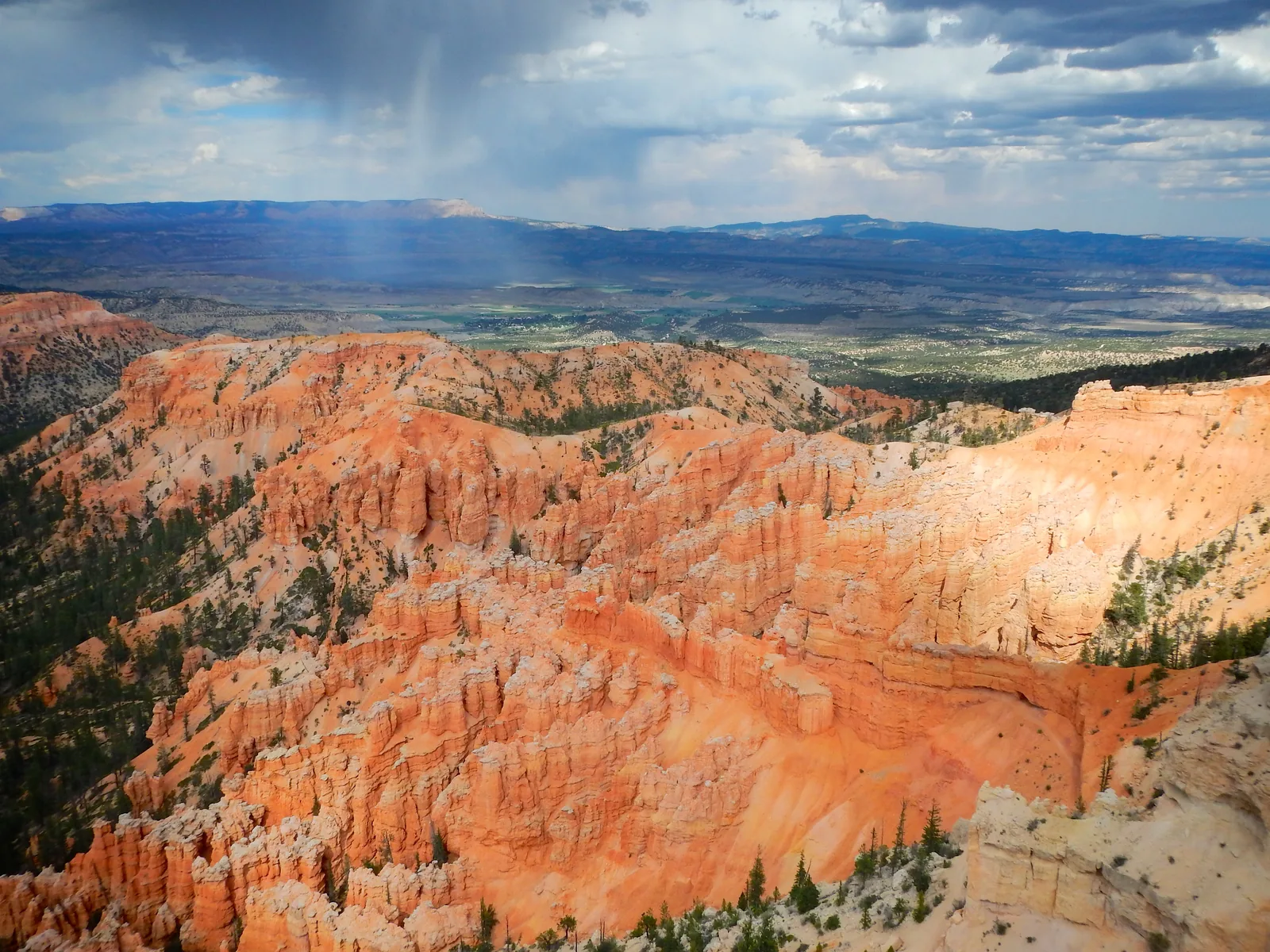
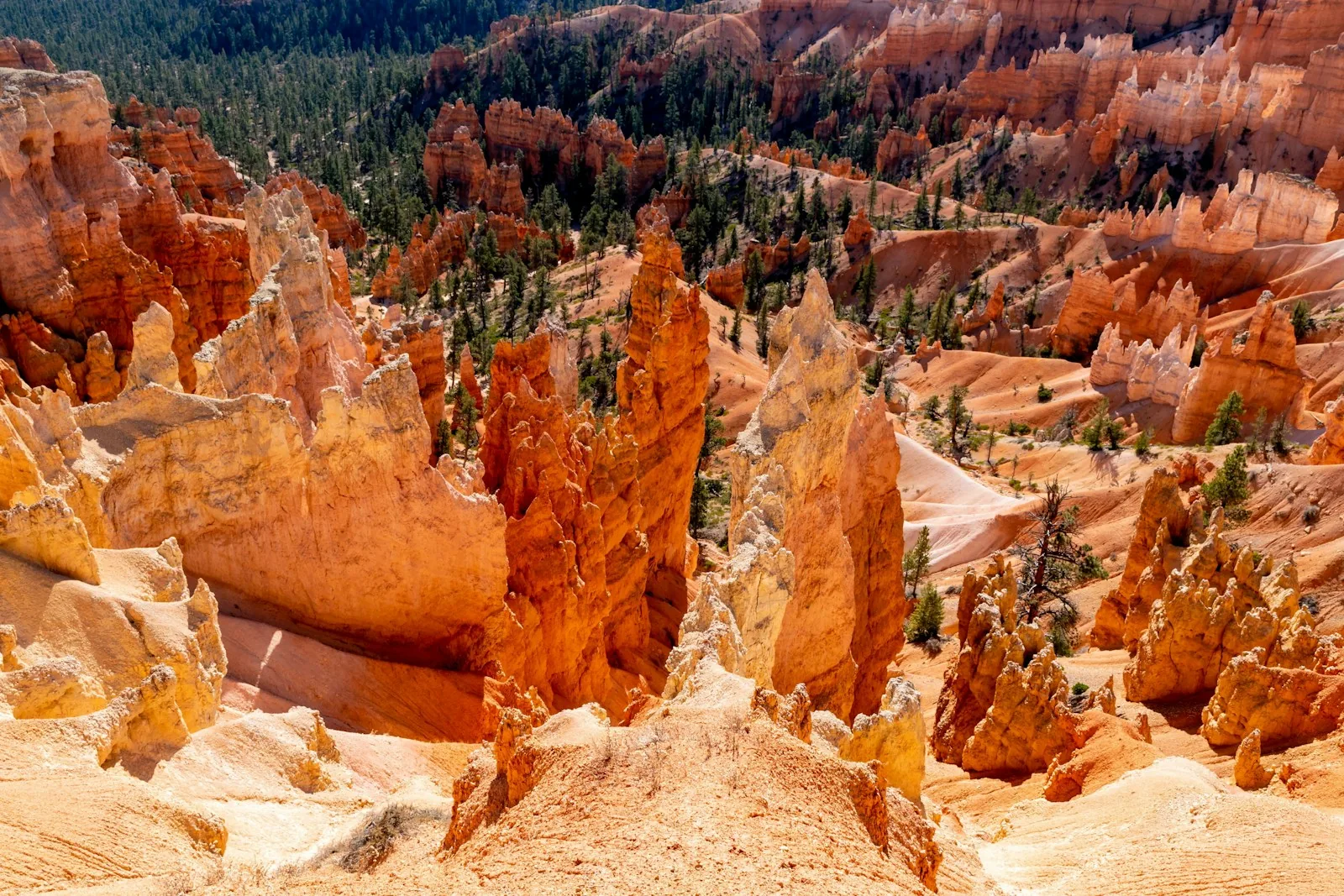
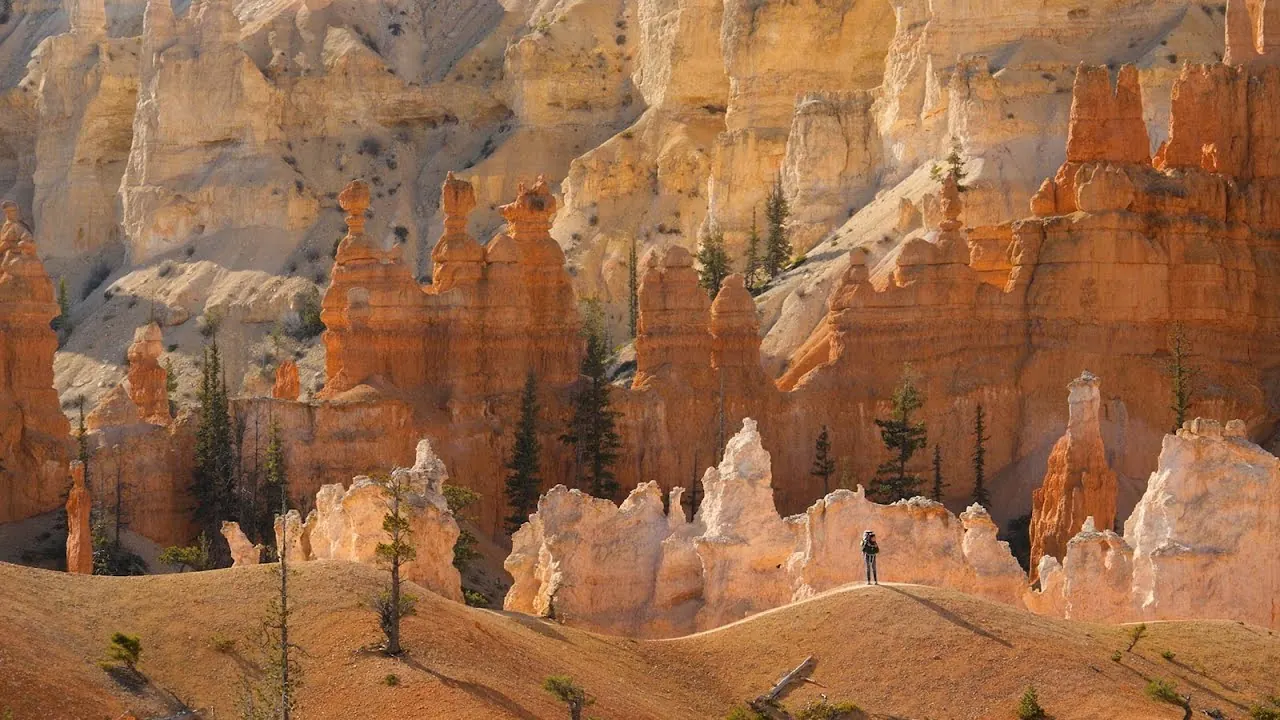
Bryce Canyon is not a canyon: the park counts more than a dozen amphitheaters, cut at least 300 metres (1,000 ft) deep into the edge of a high plateau.
First momentOn more than 170 nights a year the temperature here drops below freezing. Water freezes in the cracks of the rock and splits the edge of the plateau, piece by piece, into hoodoos.
A single main road runs through the park from north to south, 18 miles (29 km) in all. The four best-known viewpoints, Bryce Point, Inspiration Point, Sunset Point and Sunrise Point, all lie within the first three miles, on the Bryce Amphitheater. If you have more time, drive the Southern Scenic Drive to Rainbow Point and stop at the viewpoints on the way back.
There is no timed entry ticket. The park is open around the clock all year; you show your pass or pay at the entrance. After heavy snow the road can be closed for a while until it has been ploughed.
From April to mid-October a free shuttle runs through the amphitheater section every 15 minutes; a full loop takes about 50 minutes. It is covered by your entrance fee and not compulsory. The park still recommends it: the most common reason for full car parks is hikers whose cars sit at a viewpoint for hours.
The park names two places: the Shuttle Station in Bryce Canyon City outside the park, and the overflow car park opposite the visitor center. At the visitor center itself parking is limited to one hour. If you board outside the park, you have to show the driver proof of your entrance pass.
A private vehicle with up to 15 seats and all its occupants costs $35, a motorcycle $30, and a person on foot or by bike $20. The park states that the motorcycle pass is valid for seven days. Children under 16 pay nothing.
Every person aged 16 or over without US residence pays an extra $100, unless they enter with an annual pass or an America the Beautiful pass. For a couple from abroad in a hire car, $35 becomes $235.
Bryce: Guided Sightseeing Tour of Bryce Canyon National Park
Three hours by minivan with stops at Fairyland Canyon, Natural Bridge, Inspiration Point and above Wall Street, with short walks in between. In total you walk less than one kilometre (0.6 mi).
4.9 out of 5 stars · 937 reviews on GetYourGuide · from €96.83 · as of 4 Oct
3 hours
Less than 1 km (0.6 mi) on foot
Water and snacks included
No tours during thunderstorms
Departure Bryce Canyon City; the exact meeting point is in your booking confirmation.
Park admission is explicitly not included, and neither are tips. For people without US residence, that means the entrance fee plus the $100 nonresident fee per person aged 16 or over; the park’s fees page names people on commercial tours explicitly. Included are transport, guide, water, snacks and umbrellas if needed. Guided in English. The provider itself points out the risk of altitude sickness. No tours run during thunderstorms. Cancellation up to 24 hours in advance.
View tour ↗Ad · partner link · checked 25 Sep 2026
About 50 million years ago a basin with lakes and floodplains lay here. Its sediments became the Claron Formation, the uplift of the Colorado Plateau raised it to as much as 2,778 m (9,115 ft), and ice has been breaking it apart ever since.
What you see is the crumbling edge of a high plateau, as documented by the National Park Service.
The park says so itself: “The park is not a canyon.” What looks like a gorge is a series of more than a dozen amphitheaters, cut at least 300 metres (1,000 ft) deep into the eastern edge of the Paunsaugunt Plateau.
A canyon forms when a river cuts down into rock. Here no river did the work; the edge did it itself. Rain dissolves the lime that holds the rock together, and frost breaks apart what remains. Year by year the plateau retreats a little further west and leaves standing whatever is harder.
The park describes the process in three steps. Deposition: about 50 million years ago a system of lakes and floodplains lay here, and its sediments became the Claron Formation. Uplift: when the Farallon Plate broke apart beneath North America, the Colorado Plateau rose. Weathering: at this altitude it freezes and thaws on more than 170 nights a year.
Freezing water expands by nine percent. What starts as a crack becomes a gully, the gully becomes a wall, the wall gets windows, and when a window collapses, two hoodoos are left standing. The same forces that shaped them keep wearing them down.
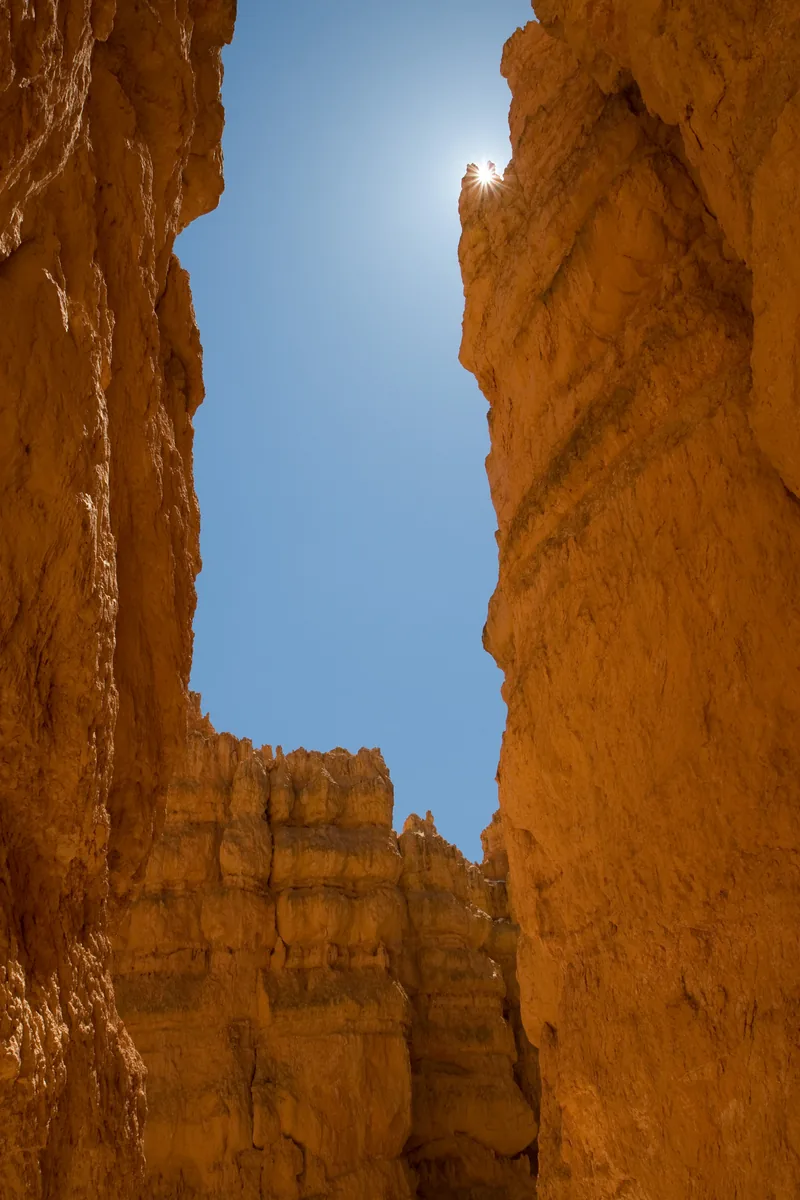
The colours come from iron in the rock, the banded shapes from layers cemented to different degrees: layers with more lime dissolve faster and recede, while harder layers remain as bulges. That is why no two hoodoos look alike.
The area has been protected since 1923, first as a national monument under the Forest Service. In 1924 it became Utah National Park, and in 1928 Bryce Canyon National Park. The name comes from Ebenezer Bryce, a settler who kept cattle here and who is said to have called it “a hell of a place to lose a cow”.
2,406 m (7,894 ft) at the visitor center, 2,778 m (9,115 ft) at the highest point
Main road
18 miles, about 29 km
Amphitheaters
more than a dozen
Depth
at least 1,000 ft, about 300 m
Rock
Claron Formation
Freeze-thaw cycles
more than 170 nights a year
National park since
25 February 1928
Nowhere denser
The largest concentration in the world
According to the park, the Bryce Amphitheater has the largest concentration of hoodoos on Earth. That is exactly why the park was established under this name in 1928.
Rim Trail and viewpoints: Sunset, Sunrise, Inspiration Point
The four best-known viewpoints lie along the first three miles (5 km) of the park road. The Rim Trail links them along the edge, and the paved Shared-Use Path runs from the entrance to Inspiration Point, open to bikes and dogs too.
The Rim Trail section between Sunset and Sunrise Point is 0.8 km (0.5 mi) long, paved and almost level; the park allows 1.6 km (1 mi) and one hour for the round trip. Apart from the Shared-Use Path, it is the only trail where dogs are allowed. The Bristlecone Loop at Rainbow Point is 1.6 km (1 mi) long and leads to the oldest trees in the park.
The Rim Trail runs 8.9 km (5.5 mi) north from Bryce Point to Fairyland Point, linking Inspiration, Sunset and Sunrise Point on the way. Walk as much of it as you like: Bryce to Inspiration Point is 2.4 km, on to Sunset Point 1.1, to Sunrise Point 0.8 and to Fairyland Point 4.5 km. Every access point except Fairyland Point has a shuttle stop. The park regularly closes the section between Bryce and Inspiration Point in winter.
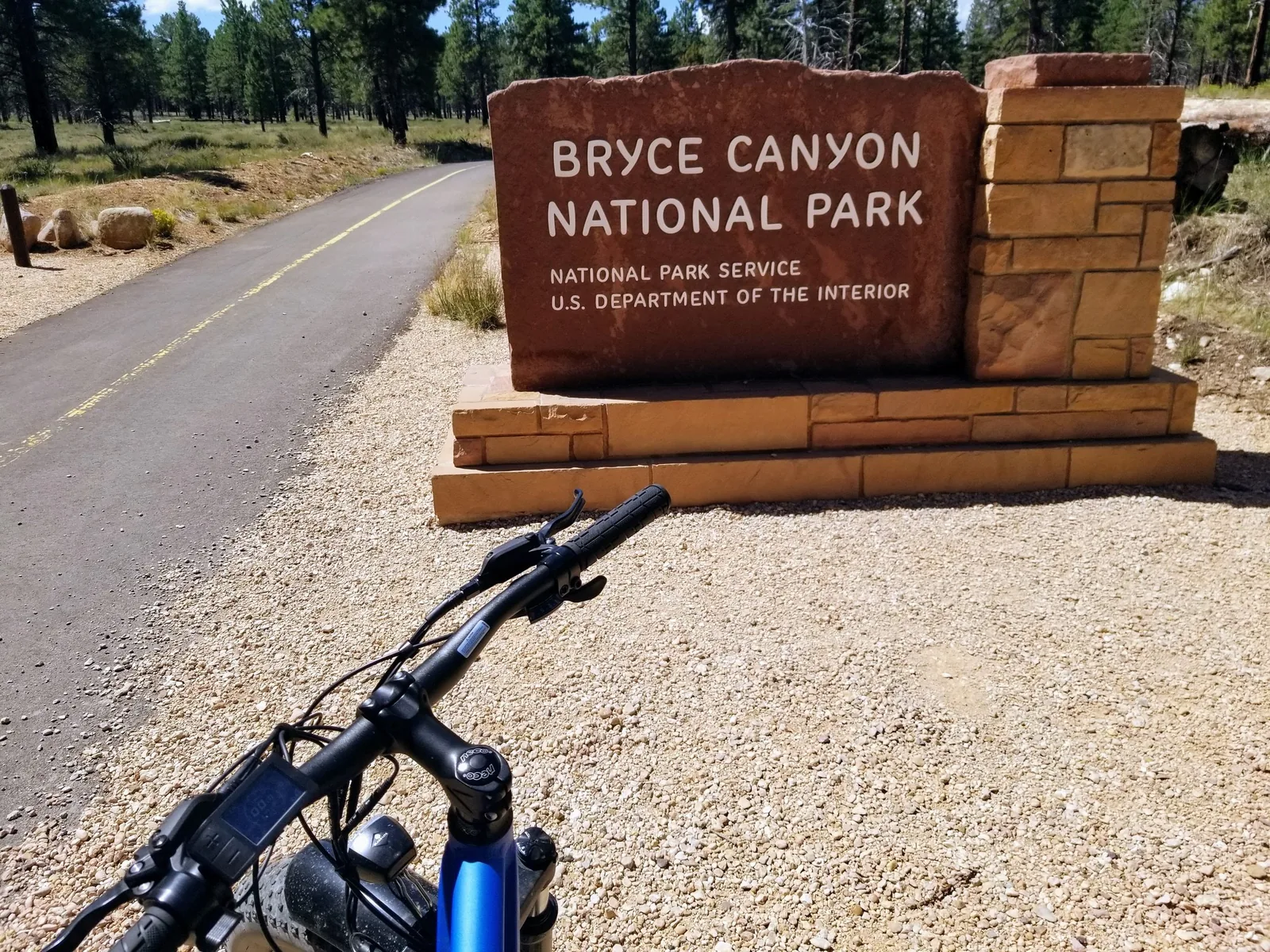
The paved Shared-Use Path runs along the rim from the park entrance to Inspiration Point. Dogs on a lead are allowed on it. You can rent bikes in the park.
Almost all viewpoints face east, so the sun sets behind you, not over the amphitheater. For sunrise the park recommends Sunrise Point and Bryce Point; for sunset, Inspiration Point or Paria View, and it suggests arriving an hour and a half early.
Bryce Canyon Scenic Tours · E-bike tour · 3.5 hours
Bryce Canyon National Park: Guided E-Bike Tour
Three and a half hours on the paved Shared-Use Path along the rim of the amphitheater, stopping at the viewpoints without having to look for parking. About 8 miles (13 km) one way and roughly 300 ft (90 m) of climbing.
4.8 out of 5 stars · 118 reviews on GetYourGuide · from €146.58 · as of 4 Oct
3.5 hours
No more than 5 participants
E-bike and helmet included
Riding yourself depends on age and height
Departure The provider’s office at Bryce Wildlife Adventure, outside the park.
The provider lists national park entrance fees as not included, and tips as well. For people without US residence, that means the entrance fee plus the $100 nonresident fee per person aged 16 or over. Included are guide, e-bike, helmet, lock, water and snacks. Guided in English. According to the description, anyone aged 12 or over, 158 to 188 cm (5 ft 2 in to 6 ft 2 in) tall and used to cycling rides their own bike; younger children ride along as passengers. Not suitable for children under three, wheelchair users, people over 150 kilograms (330 lb) or anyone who cannot ride a bike. Cancellation up to 24 hours in advance.
View tour ↗Ad · partner link · checked 25 Sep 2026
Provider's product photo · GetYourGuide
Map
26 places on the map
Viewpoints, trailheads and shuttle stops with verified locations.
Hiking below the rim: Queen’s Garden and Navajo Loop
Every trail here starts by going down and ends with the climb back up, at 2,400 metres (7,900 ft). For a first visit the park recommends the loop via Queen's Garden and the Navajo Loop: 4.6 km (2.9 mi), two to three hours.
The hike the park recommends for first-time visitors, and the one you really should not miss.
Queen’s Garden and the Navajo Loop together make 4.6 km (2.9 mi) with 191 m (625 ft) of elevation change, two to three hours. The park recommends going clockwise: down at Sunrise Point, back up the Navajo Loop to Sunset Point and along the rim to your start.
The park puts it at the top of its list twice: shoes that are not made for hiking are the most common cause of rescues and hospital visits. You need hiking boots with ankle support and a good tread; sports sandals and trainers are explicitly not considered safe. In winter, add traction devices.
The trails start at the top. Every return is a climb, and at the highest point in the park, 2,778 m (9,115 ft), you have only 70 percent of the oxygen you are used to. The park advises turning back before you get tired.
One litre every one to two hours. Sunburn dehydrates you further, so wear a hat, sunscreen and sunglasses, also against the light reflected off the pale rock. There are water refill stations at several places in the park.
Off the trail, the ground gives way even on slopes that look gentle. The park lists “Leaving the Trail” as number four on its list and recommends carrying the park map.
The visitor center sits at 7,894 ft, about 2,406 m; the highest point in the park is at 9,115 ft (2,778 m). At 8,000 ft you have only about 75 percent of the oxygen you are used to at home. If you arrive straight from the coast, take the first day easy.
The rock forms crumbling edges and steep slopes of loose debris. The park puts it vividly: the holds will not support anything heavier than a chipmunk. Climbing on the hoodoos or sliding down the slopes is prohibited and dangerous.
Bryce Canyon: guided hike on Queen's Garden and the Navajo Loop
Three hours on foot into the amphitheater: from Sunrise Point the Queen's Garden Trail leads down among the hoodoos, and the Navajo Loop climbs back up to the rim near Sunset Point, past Thor's Hammer, rock windows and arches. The guide explains how uplift, erosion and frost shaped the landscape; pace and photo stops suit the small group.
5.0 out of 5 stars · 9 reviews on GetYourGuide · from €122.45 · as of 4 Oct
3 hours
Small group or private
Moderate, steep climb
Guide in English
Departure Sunset Point in the park (map point on the page); according to the description, the hike starts at Sunrise Point and ends near Sunset Point. Start times are shown when you check availability.
According to the inclusions list, the guide, the guided hike, commentary on history, geology and wildlife, planning tips and the small group are included. Everyone needs a park pass, and people without US residence aged 16 or over pay an extra $100, also on commercial tours, unless they hold an annual pass. For the same product on Viator, the provider lists admission as not included; the route is about 3 miles (4.8 km), the meeting point is the Sunset Point shuttle stop, minimum age 8. Steep sections, switchbacks and the climb back to the rim at about 2,400 m (7,900 ft); not suitable for people with limited mobility or heart or breathing problems. Free cancellation up to 24 hours in advance.
View tour ↗Ad · partner link · checked 27 Sep 2026
With more time you can go deeper: 8.8 km (5.5 mi) on the Peekaboo Loop, clockwise only, or 12.9 km (8 mi) on the Fairyland Loop in the north, with far fewer people.
Peekaboo Loop: 8.8 km (5.5 mi) with 474 m (1,555 ft) of elevation change, clockwise only. Fairyland Loop: 12.9 km (8 mi) with 579 m (1,900 ft) and far fewer people. The figure-eight combining Queen’s Garden, Peekaboo and the Navajo Loop comes to 10.2 km (6.3 mi).
The park describes the Fairyland Loop as quiet. It first follows the rim near Boat Mesa, then runs below it among hoodoos with wide views towards the Bryce Amphitheater: 12.9 km (8 mi), 579 m (1,900 ft) of elevation change, four to five hours, recommended anticlockwise. Fairyland Point has neither a shuttle stop nor facilities; if you come by shuttle, start at the Tower Bridge access north of Sunrise Point. In midwinter the trail can be impassable under 0.7 to 5 metres of snow.
The concessioner Canyon Trail Rides offers two- and three-hour rides into the amphitheater and on the Peekaboo Loop, usually from April to 31 October. If you bring your own horse, you book fixed time slots between 16:30 and 19:30 via Recreation.gov, with no more than ten riders per slot.
For the long trail below the rim, the park gives an explicit warning: it is in poor condition in many places, and you hike it at your own risk. A map and solid navigation skills are essential, and help may be delayed.
The park road runs eighteen miles (29 km) south to Rainbow Point at 2,778 m (9,115 ft). The shuttle does not run on this section, and hardly anyone stops at many of the viewpoints.
From here you can see 100 miles of Earth’s history as a staircase, if you know what you are looking at.
From Bryce Canyon a sequence of rock steps runs 100 miles (160 km) south through Zion to the Grand Canyon. In the 1870s the geologist Clarence Dutton described it as a staircase and named five steps after their colour: the Pink, Grey, White, Vermilion and Chocolate Cliffs. Yovimpa Point is one of the few places where you can see it as a staircase.
Between miles 8 and 10 you can see the traces of the 2009 Bridge Fire, at 3,947 acres (16 km²) the largest fire in the park’s history. The piles of wood along the road, by contrast, are fire prevention: thinned timber that is burned in controlled fires under snow in January and February.
During the shuttle season, vehicles 23 ft (7 m) or longer may not park at the visitor center, Sunrise Point, Bryce Lodge, Sunset Point, Inspiration Point or Bryce Point, and never at Paria View. On the Southern Scenic Drive between miles 4 and 18 there are no such limits.
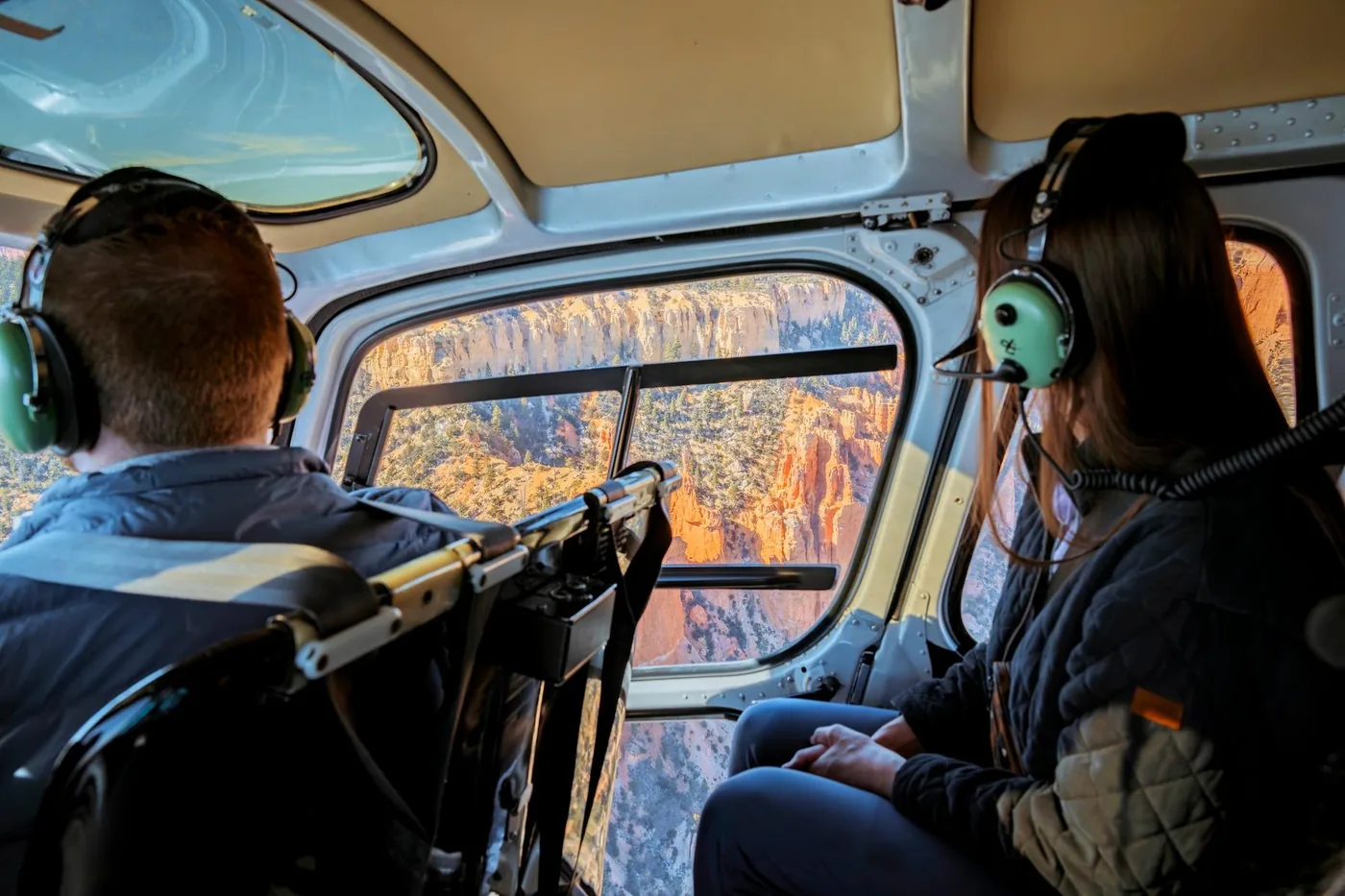
Bryce Canyon National Park: 30 Minute Helicopter Tour
About 55 miles (90 km) in half an hour: from Bryce Canyon Airport south to the eastern side of the park, with views of Fairyland, Boat Mesa and the Sinking Ship, Natural Bridge and as far as Rainbow Point, one of the highest points in the park with ancient bristlecone pines. The pilot talks about geology and history. The flight crosses the park; air tours are allowed there only on set routes and altitudes.
5.0 out of 5 stars · 4 reviews on GetYourGuide · from €274.50 · as of 4 Oct
30 minutes
Up to 6 people
Pilot commentary in English
Departs from Bryce Canyon Airport
Departure Bryce Canyon Airport north of Bryce Canyon City, outside the park: the building with the yellow-painted roof and the sign Bryce Canyon Airport.
Included are the flight, waiver and safety briefing, and the applicable fees of 11.5 percent; the pilot’s tip is not. Take-off and landing are outside the park. At least five guests, except on private flights. All guests are weighed at check-in: according to the notes, anyone weighing more than 250 lb (112 kg) and no more than 375 lb (170 kg) buys a second seat. Seats are assigned by weight and balance; flight time depends on wind and weight. Bring a passport or photo ID and a credit card; backpacks are not allowed. Under the park’s 2022 air tour management plan, flights over the park are generally allowed only from one hour after sunrise until three hours before sunset, so there is no evening flight. Free cancellation up to 24 hours in advance.
View tour ↗Ad · partner link · checked 27 Sep 2026
More checked toursAd · partner link · checked 3 Oct 2026
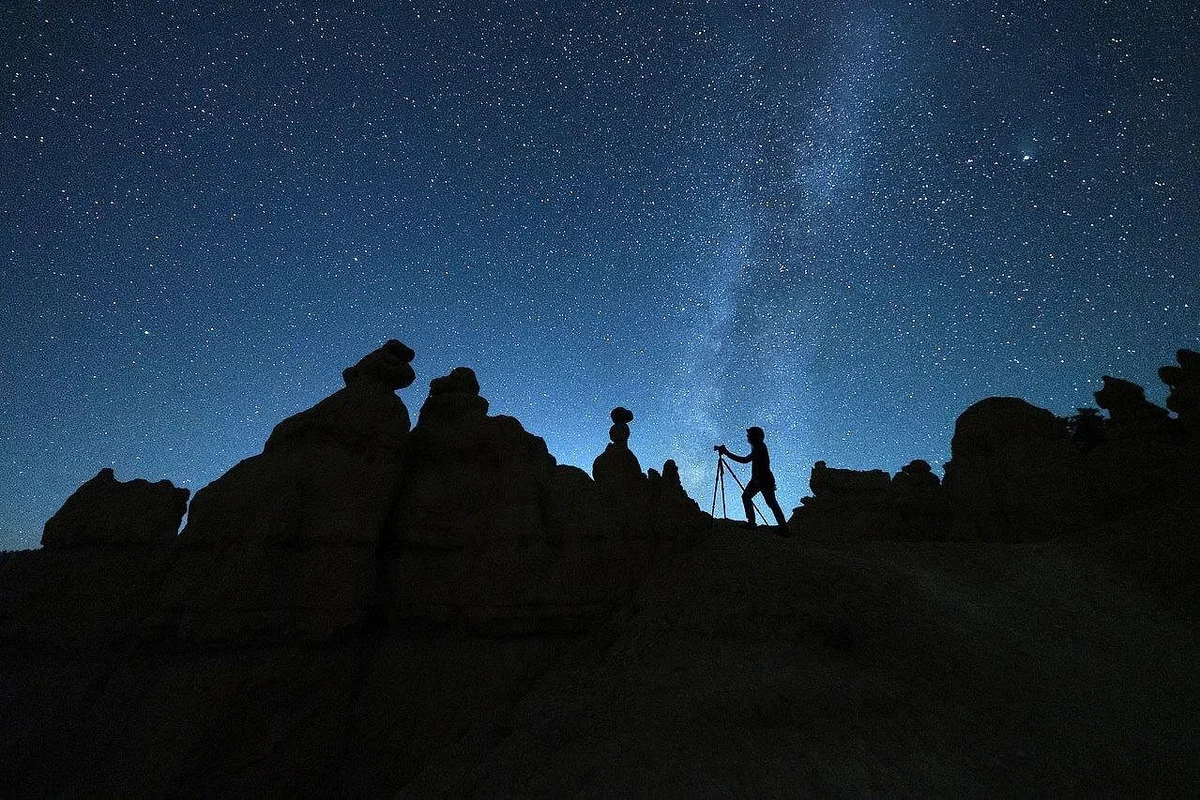
Stargazing in Bryce Canyon: International Dark Sky Park
Rangers and volunteer astronomers run about 100 astronomy programmes a year. On full moon nights they lead walks among the hoodoos, and the sky is darkest in the week of the new moon.
“On a moonless night you can see thousands of stars here, and the Milky Way stretches from horizon to horizon.”
Bryce Canyon National Park · Night sky over the hoodoos
With the rangers
At night
Bryce Canyon is a designated International Dark Sky Park. On a moonless night you can see thousands of stars, and the Milky Way stretches from horizon to horizon. Rangers and volunteer astronomers run about 100 astronomy programmes a year, plus a four-day astronomy festival in summer.
The ranger-led full moon hikes are available only via Recreation.gov: 15 tickets 14 days ahead and ten more five days ahead, each release at 10:00 Eastern Time, no more than six per booking, $1 fee. Children under eight are not admitted, shoes with good tread are required and white torches are banned. The hike is cancelled if it is cloudy or colder than −12 °C (10 °F).
Besides the astronomy evenings there are geology talks, Junior Ranger programmes and seasonal guided walks. The park’s events calendar lists them individually; many fill up quickly.
Capitol Reef Photography Tours · Astrophotography tour · 3 hours
Bryce Canyon at night: Milky Way astrophotography tour
Three hours with a local photographer: pick-up an hour after sunset, then several spots in the park to photograph hoodoos against the night sky and the Milky Way. Along the way you learn about camera settings and composition. The walk to the astro locations is about half a mile (0.8 km) each way with roughly 70 m (235 ft) of elevation change; the group is limited to four guests.
3 hours
No more than 4 guests
Pick-up included
Instruction in English
Departure Pick-up an hour after sunset at The Lodge at Bryce Canyon in the park, at the Best Western Plus Ruby's Inn or at Ruby's Inn Campground and RV Park in Bryce Canyon City, or by arrangement with the provider. The page names Sunset Point, Sunrise Point, Bryce Point and Inspiration Point as locations. When booking, choose the option “Bryce – Astrophotography Tour”; the second option is a sunrise tour.
According to the inclusions list, the ride in an air-conditioned vehicle, guiding to the photo spots and photography instruction are included; food and drink are not. The description assumes you bring your own camera. The tour takes place in the park: everyone needs a park pass, and people without US residence aged 16 or over pay an extra $100, also on commercial tours, unless they hold an annual pass. According to Viator’s data, the provider may cancel in bad weather. The walk covers about one mile (1.6 km) with roughly 70 m (235 ft) of elevation change in the dark; the tour is not recommended for people with heart problems. Not wheelchair accessible. Book at least six hours before the start; the provider confirms within 48 hours. Free cancellation up to 24 hours in advance.
View tour ↗Ad · partner link · checked 27 Sep 2026
Provider's product photo · Viator
It gets cold at night
A swing of 50 °F in one day
The daytime high and night-time low can be 50 °F apart, about 27 °C. If you set off in a T-shirt at midday, you will be cold by evening.
Sixty percent of visitors come between June and September. The park names October to May as a good time: fewer people, cooler days and, in winter, snow on red rock.
In June, highs are typically 20 to 22 °C (68 to 72 °F), in July and August 25 to 28 °C (77 to 82 °F). That is mild for a desert state; the altitude makes the difference. The rainy season falls in July and August, with short, heavy afternoon thunderstorms.
The park names October to May as a good time to visit: fewer people, cooler temperatures, autumn colours and wildflowers. Snowstorms in October are not unusual, and neither is heavy snow in March and April.
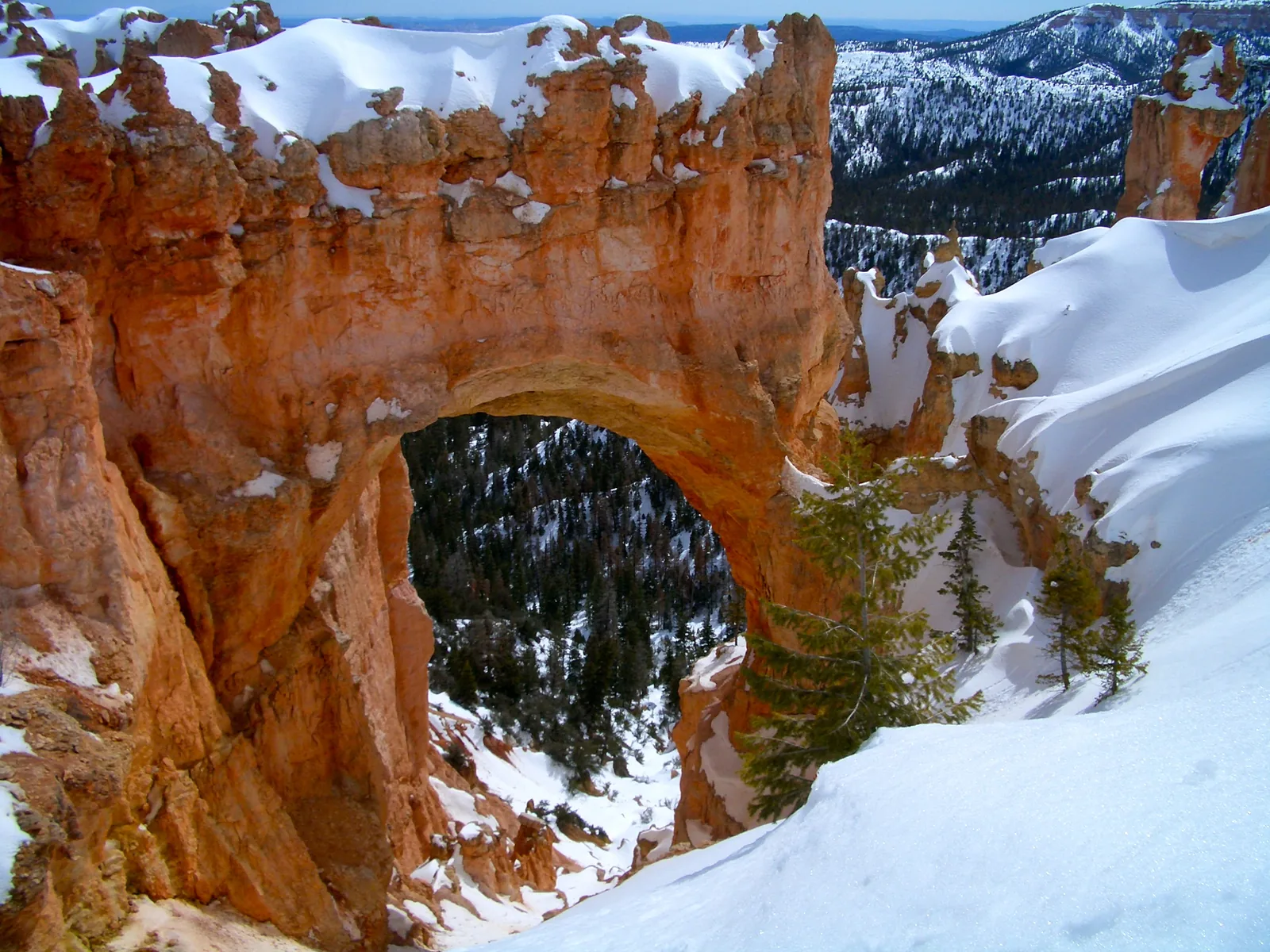
From October to May the temperature drops below freezing almost every night; it is coldest and snowiest from December to February. The park stays open, and snow on red rock is a picture no summer visitor takes home. Cross-country skiing and snowshoeing are allowed; skiing down over the rim is not.
Lightning is possible all year and most dangerous during the summer thunderstorms of July and August. If you can hear thunder, you are within 16 km (10 mi) of the lightning and should get into a building or your car at once.
The park spans about 2,000 ft (600 m) of elevation and with it three forest types: spruce-fir, ponderosa pine and pinyon-juniper. The park counts more than 100 bird species, 59 mammal and 11 reptile species and over a thousand plant species.
The Utah prairie dog now lives only in south-western Utah; its range shrank by more than 90 percent over the last century. In the early 1920s there were about 95,000 animals, by the 1970s only 3,000. In the park, reintroduction has produced more than 600 animals in ten colonies. You can see them on sunny summer days in the meadows along the road near the visitor center; from October to the end of March they hibernate. Keep your distance: their fleas can transmit diseases such as plague.
Animals that are fed become tame and aggressive. Even small rodents can bite hard enough to need stitches, and they carry diseases. Feeding wildlife is prohibited by federal law in the park and the surrounding area.
How to get there and where to stay: lodge and campgrounds
There is no public transport to the park. You stay in the historic lodge, at one of two campgrounds with a reservation, or in Bryce Canyon City right outside the park.
Access is via Highway 12 onto UT 63. The visitor center is one mile (1.6 km) past the park boundary. From the north you come via I-15 and UT 20; from the south either through Zion National Park or on UT 14 from Cedar City, a route the park calls especially beautiful in summer and early autumn.
Las Vegas (LAS) and Salt Lake City (SLC) are each about 270 miles (435 km) away. Smaller and closer are Cedar City (CDC, 80 miles) and St. George (SGU, 125 miles).
Inside the park, the free shuttle takes you to viewpoints, trailheads and facilities. If you drive yourself, you can check in advance when each car park is busiest.
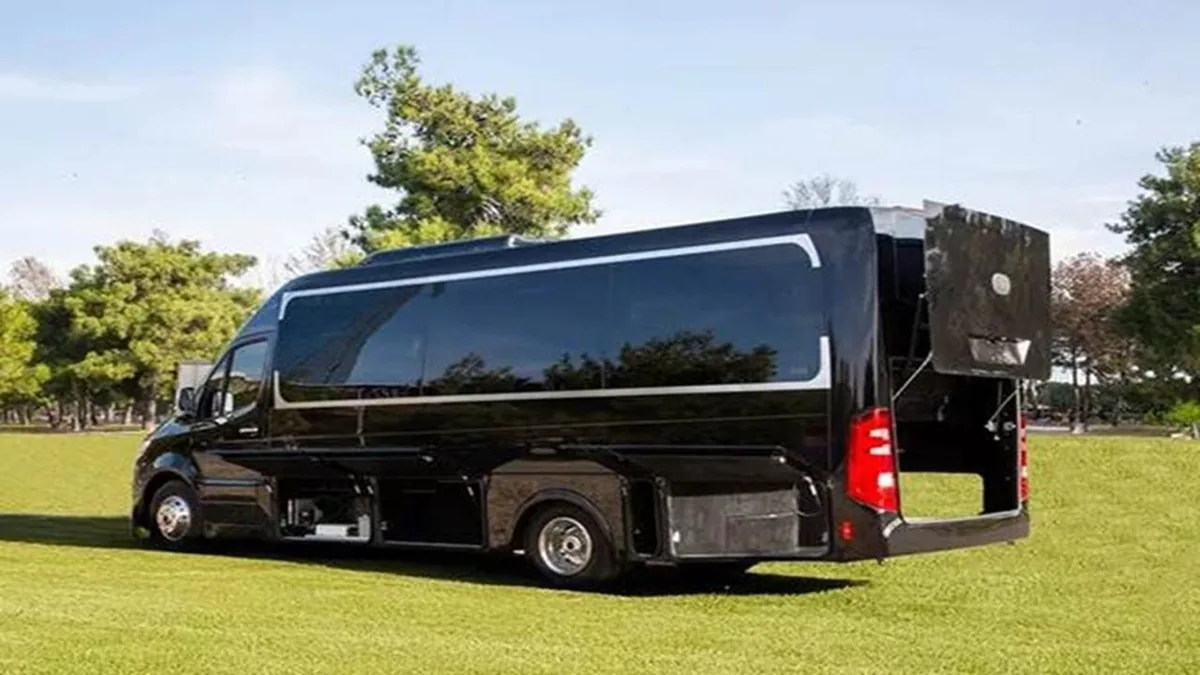
From St. George or Las Vegas: one-way shared shuttle to The Lodge at Bryce Canyon
A shared one-way shuttle without a hire car: from the Ramada hotel in St. George or the Treasure Island hotel in Las Vegas to The Lodge at Bryce Canyon in the park or to Ruby's Inn in Bryce Canyon City. According to the route plan on the page, the leg from St. George takes about two hours; from Las Vegas add an hour and a half. The return from the lodge or Ruby's Inn can be booked as a separate route.
4.3 out of 5 stars · 8 reviews on GetYourGuide · from €93.28 · as of 4 Oct
One way
Shared shuttle
Destination: The Lodge at Bryce Canyon or Ruby's Inn
1 bag per guest
Departure Ramada by Wyndham St. George, or Hotel Treasure Island (TI), 3300 Las Vegas Blvd S, tour bus pick-up area on Mystère Dreams Ave; arrival at The Lodge at Bryce Canyon in the park or at the Best Western Plus Ruby's Inn, 26 S Main St, Bryce Canyon City. Departure times are shown when you check availability.
According to the inclusions list, the one-way ride in a shared shuttle is included; tips are not. The description explains that people without US residence on commercial tours show the nonresident annual pass or pay $100 per adult, which the provider collects as the holder of a commercial use authorization. According to the route plan, the ride takes 1.5 hours to St. George and 2 more to Ruby's Inn. One bag per guest, no alcohol in the vehicle, bring ID. There is a minimum number of passengers; otherwise you are offered another date, a different experience or a refund, and the provider advises not to plan anything fixed on your arrival day. Free cancellation up to 24 hours in advance.
View tour ↗Ad · partner link · checked 27 Sep 2026
Provider's product photo · GetYourGuide
National Park Express, CHD Inc. · Day trip from Las Vegas · 13 hours
From Las Vegas: Bryce Canyon & Zion National Parks Day Tour with Lunch
Thirteen hours from the Las Vegas Strip: through the Mojave Desert and the Virgin River Gorge to Bryce Canyon, with free time on the rim, then on to Zion National Park with stops at Checkerboard Mesa and the visitor center.
3.0 out of 5 stars · 1 review on Tiqets · from €207.87 · as of 4 Oct
13 hours
Both park entrance fees included
Packed lunch and water
Not wheelchair accessible
Departure 3300 Las Vegas Boulevard South; be there ten minutes before departure.
The provider states the nonresident fee on the product page itself: $100 per person aged 16 or over, payable at check-in, unless you hold an America the Beautiful annual pass. Entrance fees for both parks are included, as are the return transport, packed lunch, water, driver and guide; tips and extra food are not. Not wheelchair accessible. Cancellation up to 24 hours in advance.
View tour ↗Ad · partner link · checked 25 Sep 2026
Provider's product photo · Tiqets
Where to stay
The Lodge at Bryce Canyon
The historic lodge is a few minutes’ walk from the amphitheater and has 114 rooms in the lodge, motel buildings and cabins, plus a dining room serving breakfast, lunch and dinner. Booking ahead is strongly recommended; closed in winter.
North Campground is open all year, Sunset Campground from mid-April to October. Both are close to the visitor center, the lodge and the amphitheater. Tent and RV sites cost $30 a night each; check-out is by 11:30.
Bryce Canyon has no first-come, first-served campsites. Bookings are made only via Recreation.gov, which sets the park apart from most of its neighbours.
The park expects the campgrounds to be full by midday at weekends from May to October. Sleeping at the roadside or in pull-outs is prohibited and enforced.
Overnight stays are allowed only at designated sites and only with a permit, collected in person at the visitor center. It costs $10 plus $5 per person, card only, for no more than 14 nights. For March to November it can be reserved three months ahead; in winter it is issued only on site, up to 48 hours in advance.
Private campgrounds and lodging are in Bryce Canyon City, right outside the park, and in the surrounding towns. Dispersed camping is allowed in parts of the neighbouring Dixie National Forest; the Forest Service sets the rules there, not the park.
This short trail on Highway 12 in the north-east leads to a mossy grotto hung with icicles in winter. The park advises against visiting between 10:00 and 18:00 and points out that cars parked outside the car park are towed.
Just over six minutes from the park’s own channel: the park, its hoodoos and the forces that shape them. A version with audio description is on the same channel.
If you travel with a dog, you will hardly leave the pavement in the park. The park itself points to neighbouring Red Canyon in Dixie National Forest: similar rock formations, and trails where dogs are allowed.
Nothing saved yet. Every place card has a pin, and so does every place on the Map. What you save collects here, with days, notes and a preview you can share.
Reality check
Share
The plan is stored in the link itself. Anyone who opens it sees the preview and can use the plan.
Image for your phone, with stops and map.
01Best time to visit: sixty percent come between June and September
Yet the park is open 365 days a year, and at its most striking in winter.
Climate through the year
Weather and climate in Bryce Canyon National Park
Best months by the climate data: May and September and October. Average daytime highs of 18 to 26 °C, lows of 4 to 11 °C, 14 to 31 mm of precipitation a month.
−10°0°10°20°30°
Jan5−6
Feb7−5
Mar12−2
Apr161
May226
Jun2912
Jul3216
Aug3015
Sep2611
Oct184
Nov11−2
Dec5−6
High °CLow °C
Daily highDaily lowPrecipitation
All monthly values as a table
Monthly averages 2001–2020, NASA POWER model
Month
High °C
Low °C
Precipitation mm
January
5.3
−5.7
23
February
7.1
−4.8
24
March
12.1
−1.7
20
April
16.3
0.9
15
May
21.9
5.8
14
June
29.3
12.0
8
July
31.5
16.5
31
August
29.7
15.2
33
September
25.7
10.8
26
October
18.4
3.9
31
November
11.0
−1.6
17
December
4.7
−5.9
21
Year
263
Modelled values, not a weather station: NASA POWER (MERRA-2) for a grid cell of about 55 × 55 km around the map point Wall Street (37.62° N, 112.17° W), with an average cell elevation of about 1,990 m. Averages for 2001–2020. Higher ground and valleys can differ markedly.
02How to get there: no bus, no train, 270 miles from Las Vegas
Without a car or a booked tour, you will not get here.
National Park Express · Shuttle · One way
From St. George or Las Vegas: one-way shared shuttle to The Lodge at Bryce Canyon
A shared one-way shuttle without a hire car: from the Ramada hotel in St. George or the Treasure Island hotel in Las Vegas to The Lodge at Bryce Canyon in the park or to Ruby's Inn in Bryce Canyon City. According to the route plan on the page, the leg from St. George takes about two hours; from Las Vegas add an hour and a half. The return from the lodge or Ruby's Inn can be booked as a separate route.
4.3 out of 5 stars · 8 reviews on GetYourGuide · from €93.28 · as of 4 Oct
Departure Ramada by Wyndham St. George, or Hotel Treasure Island (TI), 3300 Las Vegas Blvd S, tour bus pick-up area on Mystère Dreams Ave; arrival at The Lodge at Bryce Canyon in the park or at the Best Western Plus Ruby's Inn, 26 S Main St, Bryce Canyon City. Departure times are shown when you check availability.
According to the inclusions list, the one-way ride in a shared shuttle is included; tips are not. The description explains that people without US residence on commercial tours show the nonresident annual pass or pay $100 per adult, which the provider collects as the holder of a commercial use authorization. According to the route plan, the ride takes 1.5 hours to St. George and 2 more to Ruby's Inn. One bag per guest, no alcohol in the vehicle, bring ID. There is a minimum number of passengers; otherwise you are offered another date, a different experience or a refund, and the provider advises not to plan anything fixed on your arrival day. Free cancellation up to 24 hours in advance.
View tour ↗Ad · partner link · checked 27 Sep 2026
National Park Express, CHD Inc. · Day trip from Las Vegas · 13 hours
From Las Vegas: Bryce Canyon & Zion National Parks Day Tour with Lunch
Thirteen hours from the Las Vegas Strip: through the Mojave Desert and the Virgin River Gorge to Bryce Canyon, with free time on the rim, then on to Zion National Park with stops at Checkerboard Mesa and the visitor center.
3.0 out of 5 stars · 1 review on Tiqets · from €207.87 · as of 4 Oct
Departure 3300 Las Vegas Boulevard South; be there ten minutes before departure.
The provider states the nonresident fee on the product page itself: $100 per person aged 16 or over, payable at check-in, unless you hold an America the Beautiful annual pass. Entrance fees for both parks are included, as are the return transport, packed lunch, water, driver and guide; tips and extra food are not. Not wheelchair accessible. Cancellation up to 24 hours in advance.
View tour ↗Ad · partner link · checked 25 Sep 2026
Ad · we may earn a commission if you book through this partner link – at no extra cost to you. Thank you for supporting the atlas. Offer details checked 27 Sep 2026. See official ticket information.
03Tickets & entrance fees: $35 per car, plus $100 per person without US residence
Bryce Canyon is one of the eleven parks that charge the nonresident fee.
Bryce Canyon states it on its own fees page, more clearly than most parks: the fee also applies to people without US residence who enter as part of a commercial tour group, a CUA group or a concessioner tour.
Since June 2026, operators can pay the entrance fee and the nonresident fee in advance with a Commercial Site Pass on Recreation.gov, and buy digital annual passes for their guests.
The America the Beautiful nonresident pass costs $250 and removes the fee at all eleven parks. In a commercial tour group it covers the pass holder and three more people aged 16 or over. Accepted proof of US residency is a US passport, a state driver’s licence or state ID, or a green card; anyone aged 15 or under pays neither the entrance fee nor the nonresident fee.
Zion is 78 miles (126 km) away and is also on the surcharge list. Without a pass, a couple pays $470 at the two parks together; the nonresident annual pass costs $250 and is valid for twelve months.
Bryce Canyon sells its own annual pass for $70. The park lists it as “Available to: US citizens and residents”, so visitors from abroad cannot buy it. Since 2026, the fee-free days of the year have also applied only to US residents.
Bryce: Guided Sightseeing Tour of Bryce Canyon National Park
Three hours by minivan with stops at Fairyland Canyon, Natural Bridge, Inspiration Point and above Wall Street, with short walks in between. In total you walk less than one kilometre (0.6 mi).
4.9 out of 5 stars · 937 reviews on GetYourGuide · from €96.83 · as of 4 Oct
Departure Bryce Canyon City; the exact meeting point is in your booking confirmation.
Park admission is explicitly not included, and neither are tips. For people without US residence, that means the entrance fee plus the $100 nonresident fee per person aged 16 or over; the park’s fees page names people on commercial tours explicitly. Included are transport, guide, water, snacks and umbrellas if needed. Guided in English. The provider itself points out the risk of altitude sickness. No tours run during thunderstorms. Cancellation up to 24 hours in advance.
View tour ↗Ad · partner link · checked 25 Sep 2026
Bryce Canyon Scenic Tours · E-bike tour · 3.5 hours
Bryce Canyon National Park: Guided E-Bike Tour
Three and a half hours on the paved Shared-Use Path along the rim of the amphitheater, stopping at the viewpoints without having to look for parking. About 8 miles (13 km) one way and roughly 300 ft (90 m) of climbing.
4.8 out of 5 stars · 118 reviews on GetYourGuide · from €146.58 · as of 4 Oct
Departure The provider’s office at Bryce Wildlife Adventure, outside the park.
The provider lists national park entrance fees as not included, and tips as well. For people without US residence, that means the entrance fee plus the $100 nonresident fee per person aged 16 or over. Included are guide, e-bike, helmet, lock, water and snacks. Guided in English. According to the description, anyone aged 12 or over, 158 to 188 cm (5 ft 2 in to 6 ft 2 in) tall and used to cycling rides their own bike; younger children ride along as passengers. Not suitable for children under three, wheelchair users, people over 150 kilograms (330 lb) or anyone who cannot ride a bike. Cancellation up to 24 hours in advance.
View tour ↗Ad · partner link · checked 25 Sep 2026
National Park Express · Shuttle · One way
From St. George or Las Vegas: one-way shared shuttle to The Lodge at Bryce Canyon
A shared one-way shuttle without a hire car: from the Ramada hotel in St. George or the Treasure Island hotel in Las Vegas to The Lodge at Bryce Canyon in the park or to Ruby's Inn in Bryce Canyon City. According to the route plan on the page, the leg from St. George takes about two hours; from Las Vegas add an hour and a half. The return from the lodge or Ruby's Inn can be booked as a separate route.
4.3 out of 5 stars · 8 reviews on GetYourGuide · from €93.28 · as of 4 Oct
Departure Ramada by Wyndham St. George, or Hotel Treasure Island (TI), 3300 Las Vegas Blvd S, tour bus pick-up area on Mystère Dreams Ave; arrival at The Lodge at Bryce Canyon in the park or at the Best Western Plus Ruby's Inn, 26 S Main St, Bryce Canyon City. Departure times are shown when you check availability.
According to the inclusions list, the one-way ride in a shared shuttle is included; tips are not. The description explains that people without US residence on commercial tours show the nonresident annual pass or pay $100 per adult, which the provider collects as the holder of a commercial use authorization. According to the route plan, the ride takes 1.5 hours to St. George and 2 more to Ruby's Inn. One bag per guest, no alcohol in the vehicle, bring ID. There is a minimum number of passengers; otherwise you are offered another date, a different experience or a refund, and the provider advises not to plan anything fixed on your arrival day. Free cancellation up to 24 hours in advance.
View tour ↗Ad · partner link · checked 27 Sep 2026
Ad · we may earn a commission if you book through this partner link – at no extra cost to you. Thank you for supporting the atlas. Offer details checked 27 Sep 2026. See official ticket information.
The park keeps its own ranking of the causes of injury.
Get Lost Tour Company LLC · Guided hike · 3 hours
Bryce Canyon: guided hike on Queen's Garden and the Navajo Loop
Three hours on foot into the amphitheater: from Sunrise Point the Queen's Garden Trail leads down among the hoodoos, and the Navajo Loop climbs back up to the rim near Sunset Point, past Thor's Hammer, rock windows and arches. The guide explains how uplift, erosion and frost shaped the landscape; pace and photo stops suit the small group.
5.0 out of 5 stars · 9 reviews on GetYourGuide · from €122.45 · as of 4 Oct
Departure Sunset Point in the park (map point on the page); according to the description, the hike starts at Sunrise Point and ends near Sunset Point. Start times are shown when you check availability.
According to the inclusions list, the guide, the guided hike, commentary on history, geology and wildlife, planning tips and the small group are included. Everyone needs a park pass, and people without US residence aged 16 or over pay an extra $100, also on commercial tours, unless they hold an annual pass. For the same product on Viator, the provider lists admission as not included; the route is about 3 miles (4.8 km), the meeting point is the Sunset Point shuttle stop, minimum age 8. Steep sections, switchbacks and the climb back to the rim at about 2,400 m (7,900 ft); not suitable for people with limited mobility or heart or breathing problems. Free cancellation up to 24 hours in advance.
View tour ↗Ad · partner link · checked 27 Sep 2026
Capitol Reef Photography Tours · Astrophotography tour · 3 hours
Bryce Canyon at night: Milky Way astrophotography tour
Three hours with a local photographer: pick-up an hour after sunset, then several spots in the park to photograph hoodoos against the night sky and the Milky Way. Along the way you learn about camera settings and composition. The walk to the astro locations is about half a mile (0.8 km) each way with roughly 70 m (235 ft) of elevation change; the group is limited to four guests.
Departure Pick-up an hour after sunset at The Lodge at Bryce Canyon in the park, at the Best Western Plus Ruby's Inn or at Ruby's Inn Campground and RV Park in Bryce Canyon City, or by arrangement with the provider. The page names Sunset Point, Sunrise Point, Bryce Point and Inspiration Point as locations. When booking, choose the option “Bryce – Astrophotography Tour”; the second option is a sunrise tour.
According to the inclusions list, the ride in an air-conditioned vehicle, guiding to the photo spots and photography instruction are included; food and drink are not. The description assumes you bring your own camera. The tour takes place in the park: everyone needs a park pass, and people without US residence aged 16 or over pay an extra $100, also on commercial tours, unless they hold an annual pass. According to Viator’s data, the provider may cancel in bad weather. The walk covers about one mile (1.6 km) with roughly 70 m (235 ft) of elevation change in the dark; the tour is not recommended for people with heart problems. Not wheelchair accessible. Book at least six hours before the start; the provider confirms within 48 hours. Free cancellation up to 24 hours in advance.
View tour ↗Ad · partner link · checked 27 Sep 2026
Ad · we may earn a commission if you book through this partner link – at no extra cost to you. Thank you for supporting the atlas. Offer details checked 27 Sep 2026. See official ticket information.
06Frequently asked questions: Bryce Canyon
Do I need a reservation for Bryce Canyon?
No. You do not need a timed entry slot; you show your pass or pay at the entrance. You only need to book the extras: both campgrounds, the lodge, backcountry permits and the full moon hikes.
A private vehicle with all its occupants costs $35, a motorcycle $30, and a person on foot or by bike $20; the motorcycle pass is valid for seven days. Children under 16 pay nothing. The park does not accept cash.
Do international visitors pay the $100 nonresident fee?
Yes. Bryce Canyon is one of the eleven parks that, since 2026, charge an extra $100 per person aged 16 or over without US residence. The fees page explicitly includes people on commercial tours, CUA groups and concessioner tours. If you enter with an annual pass or an America the Beautiful pass, you do not pay it.
No, it is not compulsory anywhere in the park. It is covered by your entrance fee, runs every 15 minutes from April to mid-October and serves the four main viewpoints. Dogs are not allowed on board. With a vehicle 23 ft (7 m) or longer it is especially worthwhile, because you can hardly park anywhere in the amphitheater section.
What is the best hike in Bryce Canyon if I only have a few hours?
For first-time visitors the park recommends the loop combining Queen’s Garden and the Navajo Loop: 4.6 km (2.9 mi), 191 m (625 ft) of elevation change, two to three hours, clockwise. With less time or energy, walk the paved 0.8 km (0.5 mi) of the Rim Trail between Sunset and Sunrise Point.
Where is the best place to watch the sunset in Bryce Canyon?
Not at Sunset Point. Almost all viewpoints face east, so the sun sets behind you. For sunset the park recommends Inspiration Point or Paria View and suggests arriving an hour and a half early. For sunrise it names Sunrise Point and Bryce Point.
How high is Bryce Canyon, and is the altitude a problem?
The visitor center is at 2,406 m (7,894 ft), the highest point at 2,778 m (9,115 ft). At 8,000 ft you have only about 75 percent of the oxygen you are used to. Altitude sickness can affect anyone; people with heart or lung conditions are at higher risk. The trails start at the top, so the way back is always the climb.
No. Bryce Canyon has no first-come, first-served sites; both campgrounds are booked only via Recreation.gov. At weekends from May to October they are often full by midday. Sleeping at the roadside is prohibited.
Only on paved surfaces: roads, car parks, campgrounds, the paved viewpoints (except Piracy Point), the Shared-Use Path and the 0.8 km (0.5 mi) of Rim Trail between Sunset and Sunrise Point. Dogs are not allowed on any other trail or on the shuttle. The park itself points to neighbouring Red Canyon.
Via Recreation.gov, and it is a race: 15 tickets are released 14 days ahead and ten more five days ahead, each time at 10:00 Eastern Time (16:00 in Central Europe). No more than six tickets per booking, $1 fee. You must check in by 15:00 on the day of the hike; your shoe tread is checked.
Researched 25 Sep 2026. Not a live status. Dates apply only to the year stated. A successful automatic fetch is not an editorial confirmation; outdated automatic values are hidden and replaced by the source link.
About 50 million years ago there was a basin here with lakes and floodplains. Streams carried in material from higher ground to the west, which became limestone, dolomite, siltstone, mudstone and sandstone: the Claron Formation.
The Farallon Plate slid beneath the North American Plate. When it broke apart, heat rose and lifted the Colorado Plateau. Rock that formed near sea level now reaches 2,778 m (9,115 ft); the park calls this the “Goldilocks zone”, exactly the right altitude for the next step.
On more than 170 nights a year the temperature drops below freezing after being above it during the day. Water seeps into cracks, freezes and expands by nine percent. This frost wedging breaks the plateau edge first into walls, then into windows and finally into individual hoodoos.
All the layers contain lime, which dissolves in slightly acidic rainwater. Because the layers are cemented to different degrees, some stand out and others recede, hence the banded, knobbly silhouettes.