Joshua Tree is not one of the eleven parks with the $100 surcharge for visitors without US residence. International visitors pay the same here as everyone else.
Since 2026 the National Park Service has charged an extra fee of $100 per person aged 16 or over without US residence at eleven particularly busy parks: Acadia, Bryce Canyon, Everglades, Glacier, Grand Canyon, Grand Teton, Rocky Mountain, Sequoia & Kings Canyon, Yellowstone, Yosemite and Zion. Joshua Tree is not on that list.
For this park alone, the $250 pass therefore makes no sense: $30 for seven days is hard to beat. As soon as a surcharge park is added, though, the sums turn around: two adults pay $265 for Joshua Tree and Grand Canyon separately, more than the pass, which is valid for a year at all federal recreation sites.
If you still have an America the Beautiful Pass from 2025, you are better off: it is valid for twelve months from purchase on the old terms and covers entry and surcharge for everyone travelling in the private vehicle.
Visiting Joshua Tree: the park is always open, the facilities are not
01
Open around the clock
The park is open 24 hours a day, all year. There is no timed-entry booking or entry reservation: unlike Yosemite or Arches, you can simply drive in. The entrance booths are only staffed during the day; if you arrive earlier or later, you pay afterwards.
The main visitor centre in Twentynine Palms is open 8:00 to 17:00, the Joshua Tree Visitor Center in the town of the same name 7:30 to 17:00, the Cottonwood Visitor Center in the south 8:30 to 16:00 and the Black Rock Nature Center 8:00 to 16:00 with a lunch break. All four are on the edge of the park; there is no staffed facility in the interior.
No fuel, no restaurant, no shop. Drinking water only at three filling stations on the edge: Black Rock Nature Center, West Entrance Station and the main visitor centre. The centre of the park has no drinking water.
The park authority states clearly that there is no mobile network in the park. Print digital entry tickets or load them onto your device in advance, and have your maps available offline.
About 3,200 square kilometres (1,240 sq mi) where the Mojave Desert, the Colorado Desert and the Little San Bernardino Mountains meet. Franklin D. Roosevelt protected the area as a National Monument in 1936; it has been a national park since 1994.
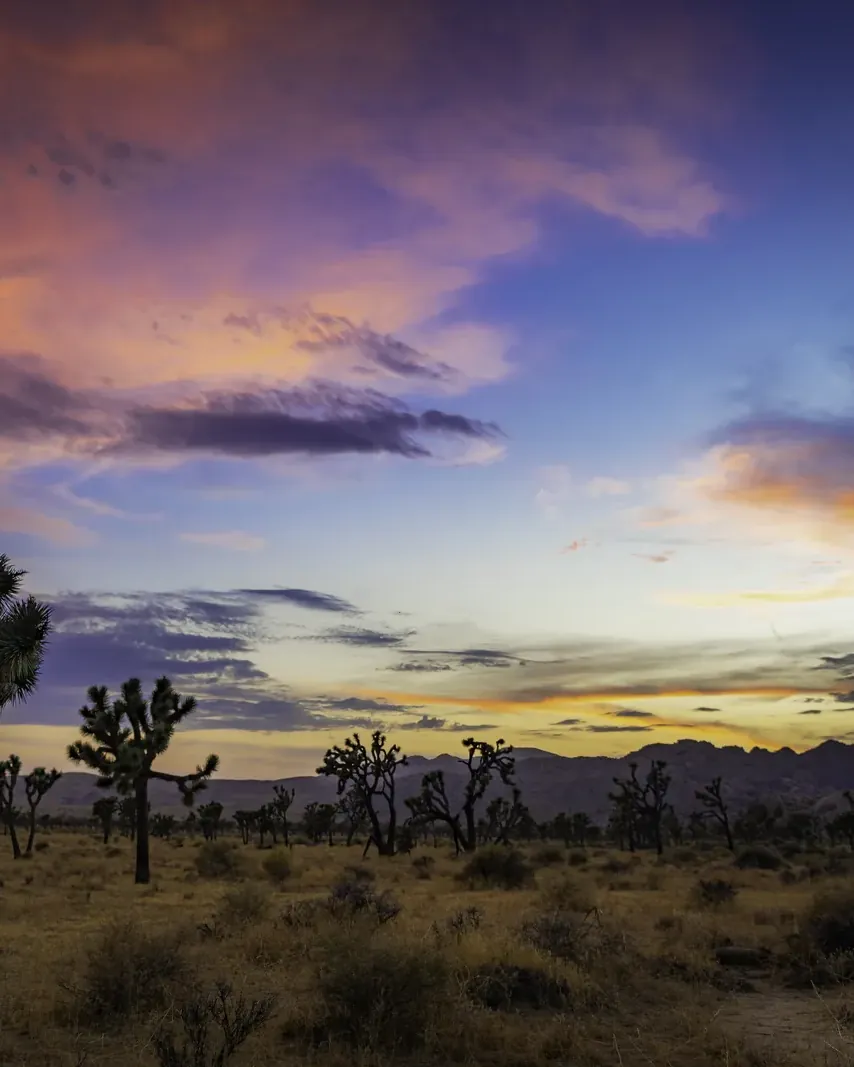
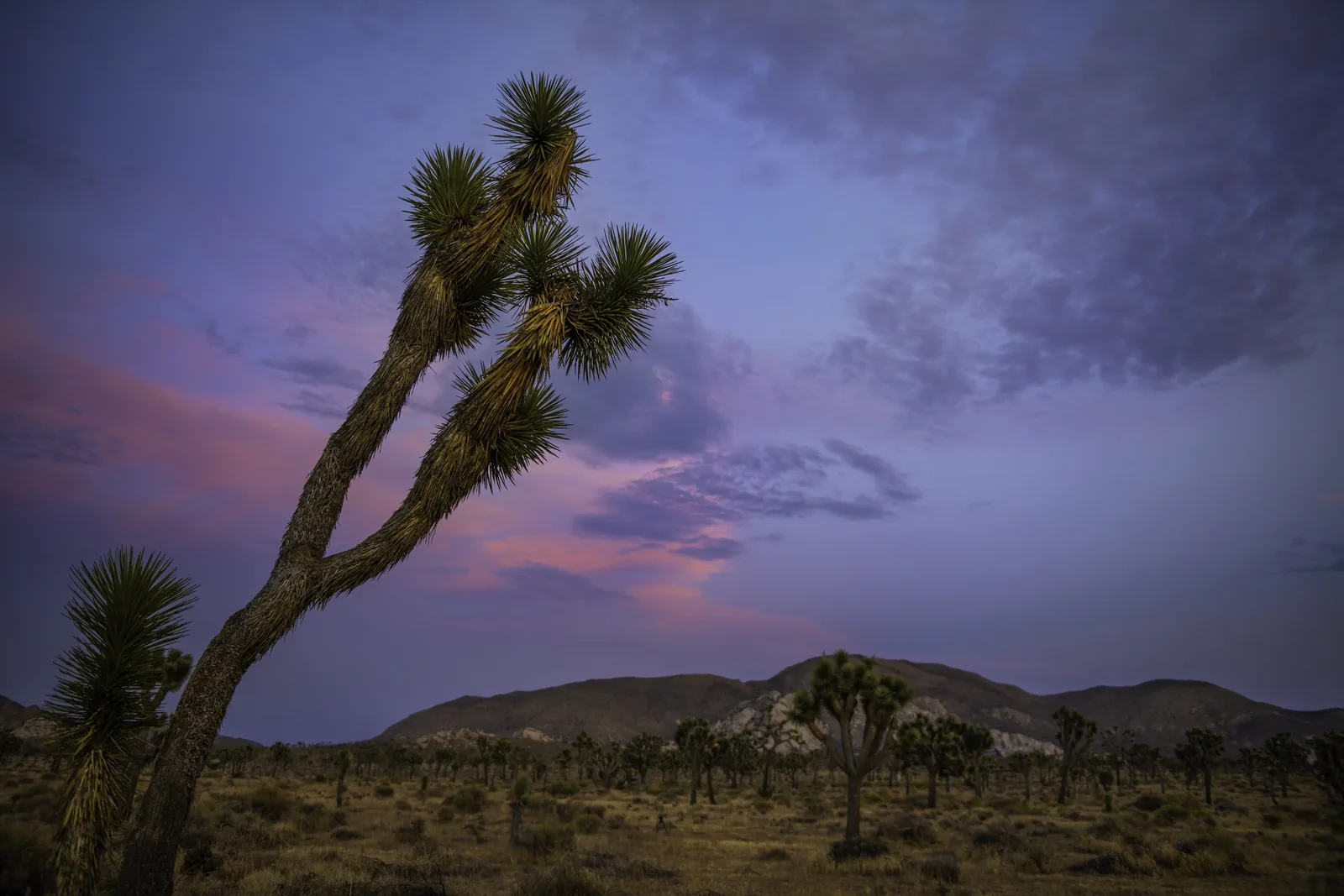
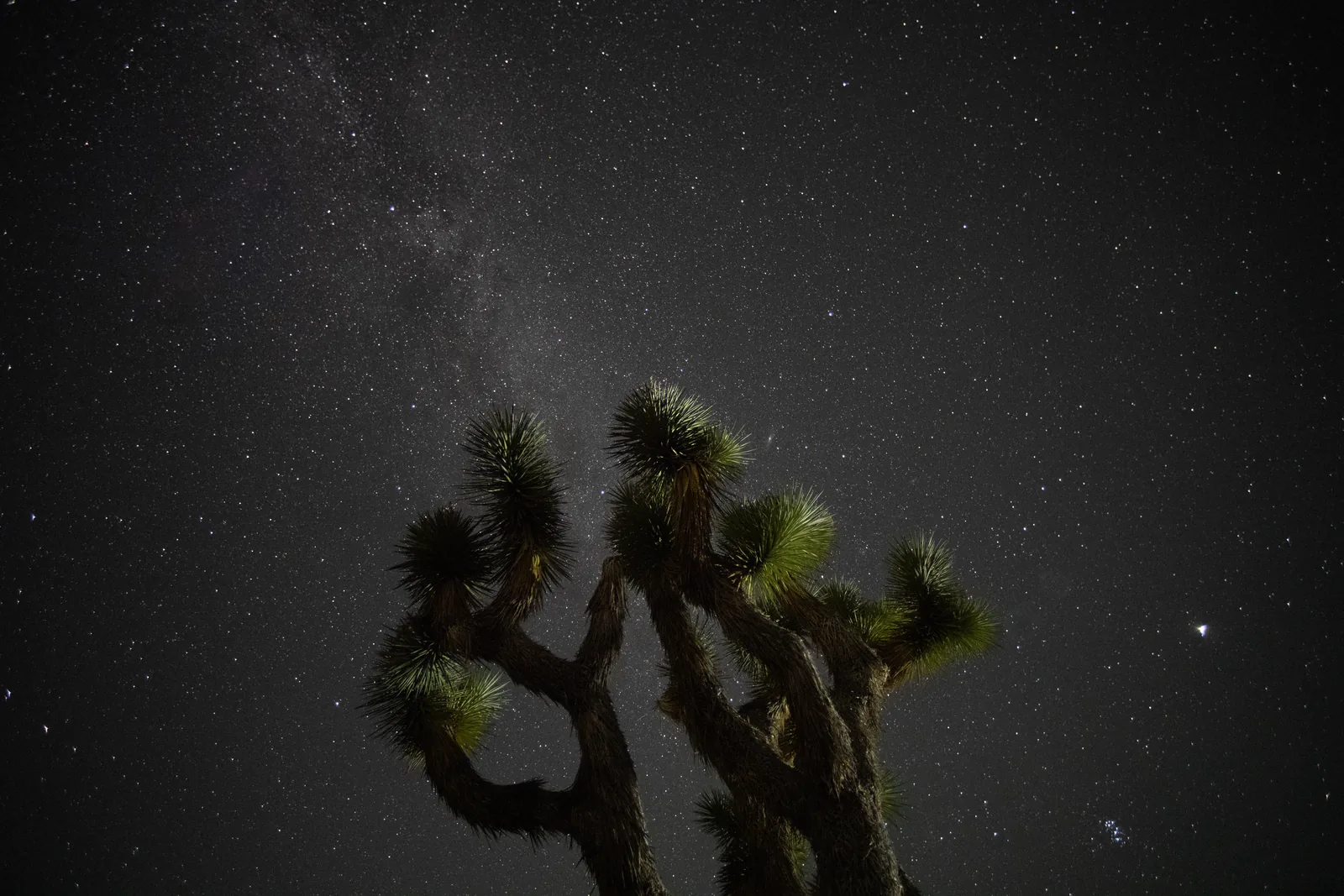
„From four parking areas you are allowed to watch the Milky Way here: awake, and within six metres of your car.“
Joshua Tree National Park · night sky above a Joshua tree
Hikes & routes: short trails, long climbs, very dark nights
The short trails
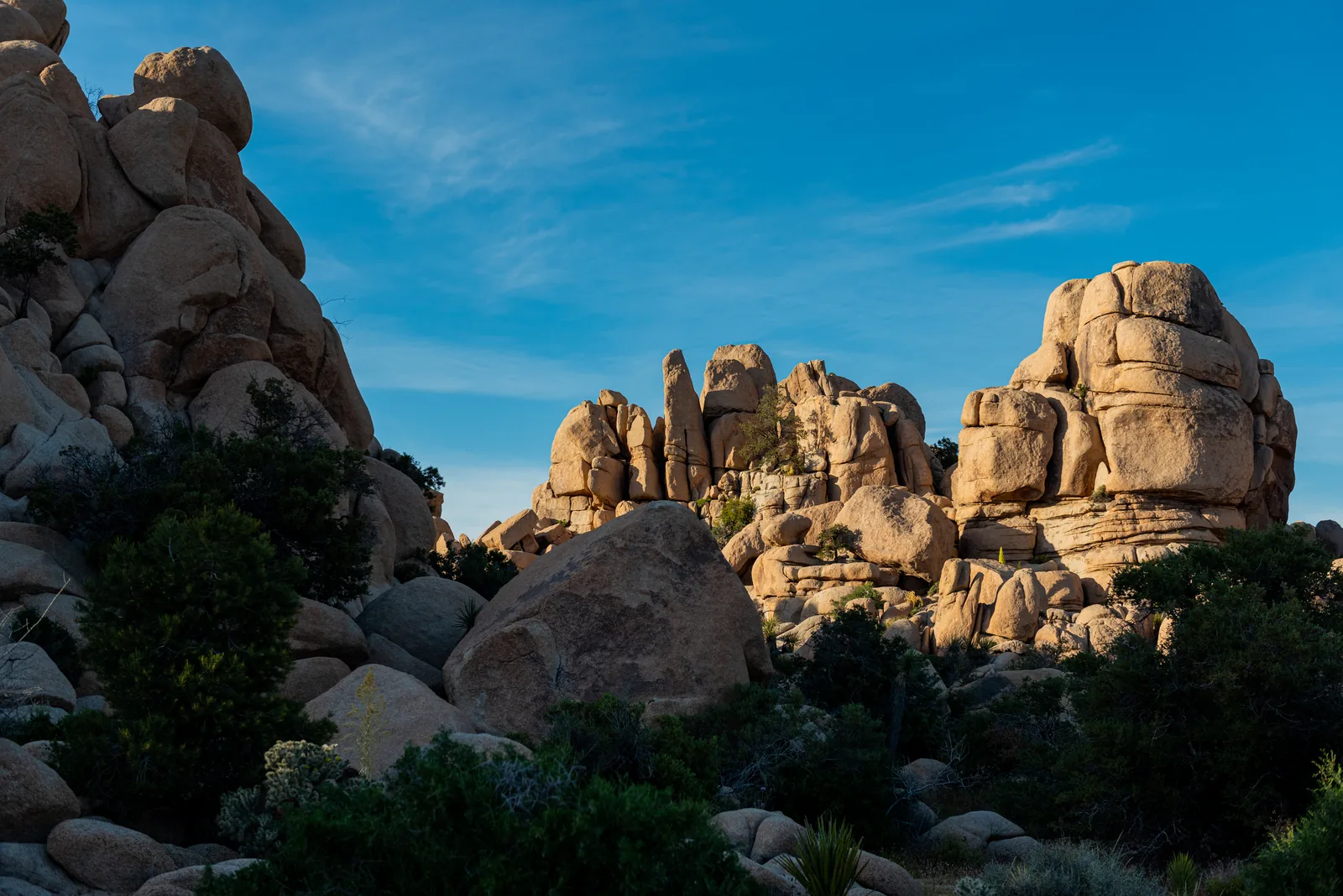
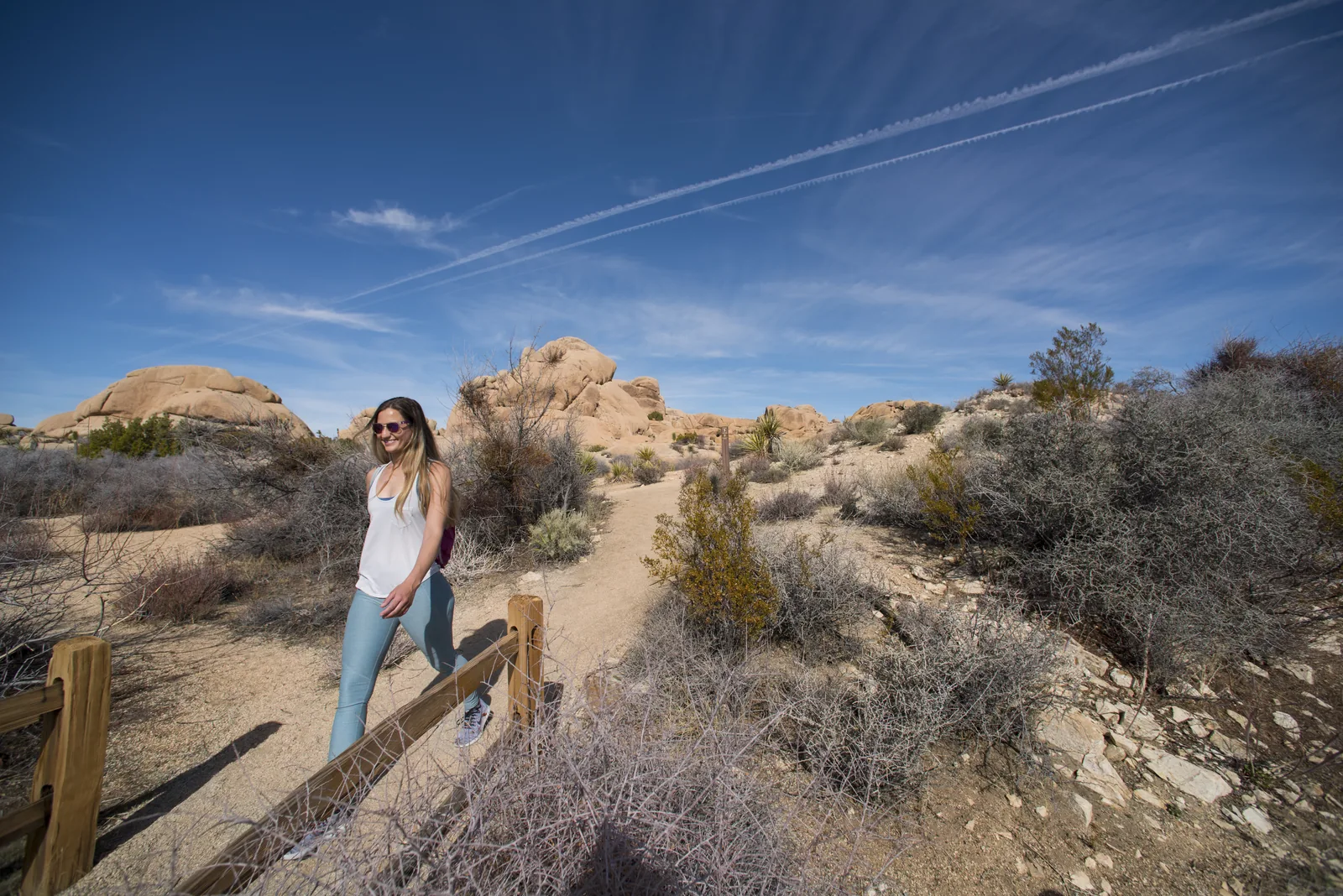
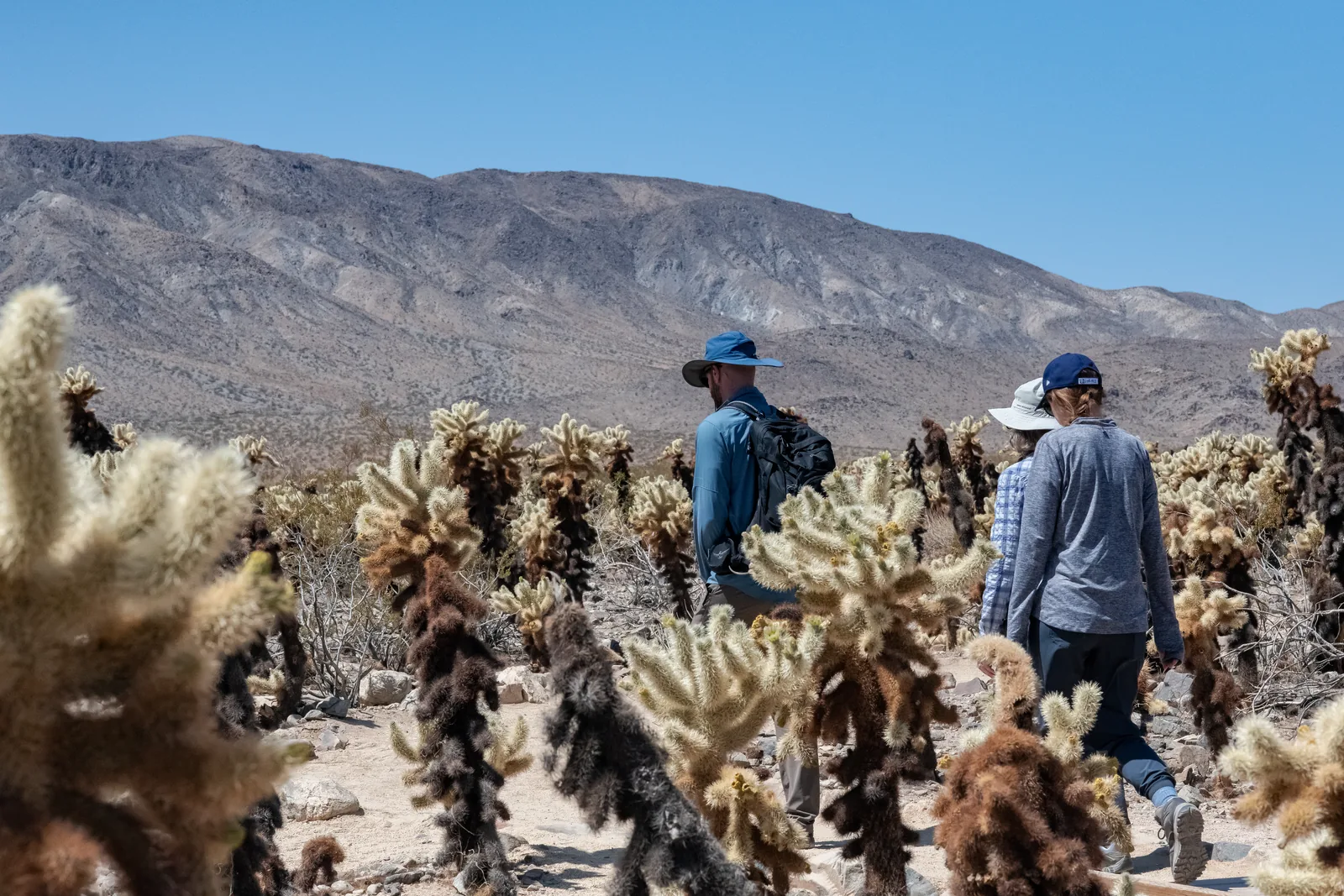
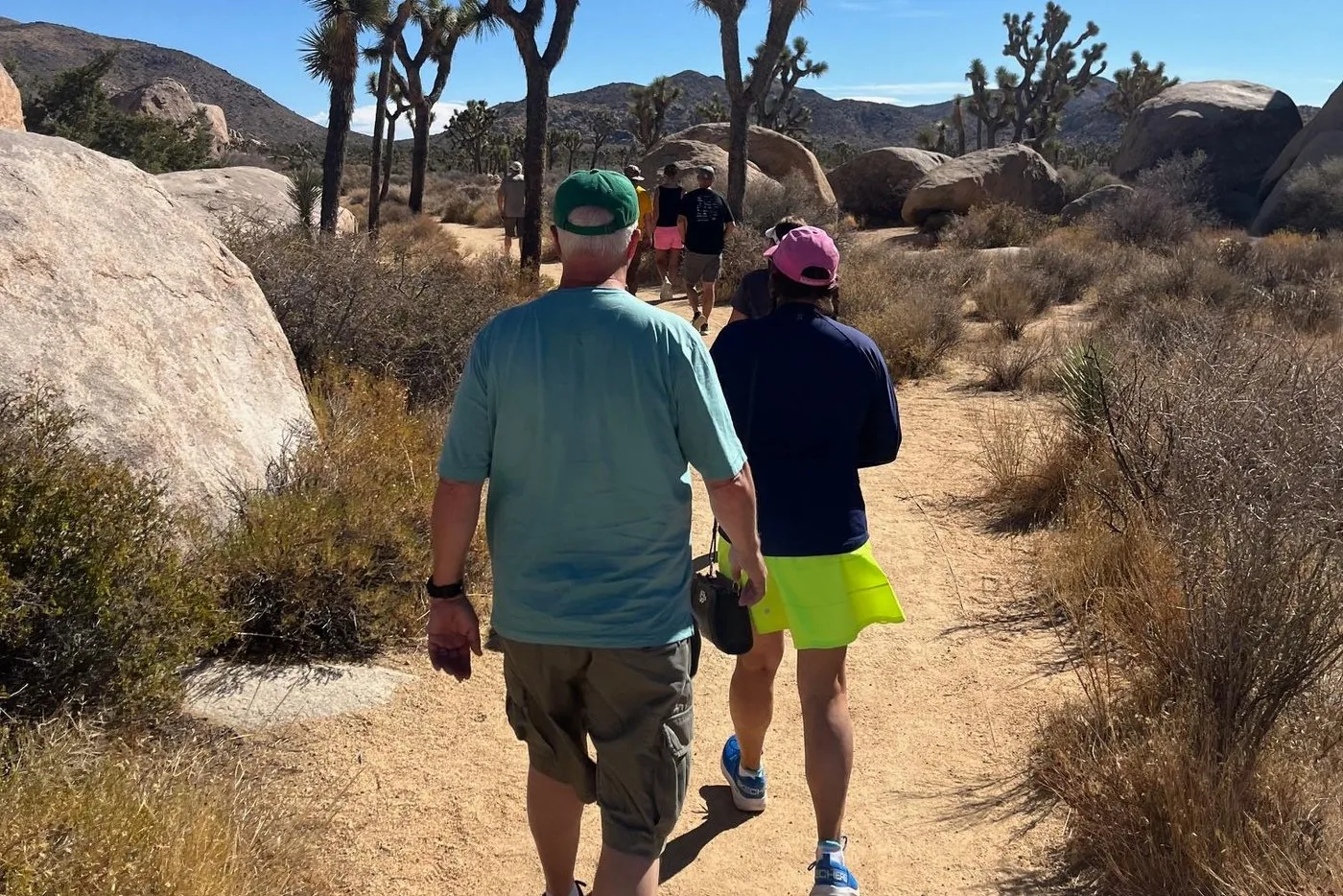
Hidden Valley (1.6 km (1 mi), one hour) leads into a valley enclosed by rock walls. Barker Dam (1.8 km (1.1 mi)) goes to a ranchers' reservoir where bighorn sheep appear. The Cholla Cactus Garden (0.4 km (0.25 mi)) winds through thousands of teddybear cholla, Skull Rock (2.7 km (1.7 mi)) through the boulders at Jumbo Rocks. Keys View is a steep paved path 400 m (1,300 ft) long to a view over the Coachella Valley.
The most popular summit trail: 4.8 km (3 mi) return, 320 m (1,050 ft) of ascent, one and a half to two and a half hours. From the ridge you overlook the entire Mojave part of the park.
Fortynine Palms (4.8 km (3 mi), 91 m (300 ft) of ascent) crosses a ridge and drops into a rocky canyon with fan palms. Lost Palms Oasis from Cottonwood Spring is the longest day hike at 12 km (7.5 mi) and five to six hours. The park rates both as strenuous and explicitly advises against them in the heat.
More than 8,000 climbing routes and 2,000 boulder problems on monzogranite make the park one of the most important climbing areas in the world, known for crack and slab climbing. Only operators with a park permit may offer guided courses; the park authority requires PCGI or AMGA certification, Wilderness First Aid and insurance.
Joshua Tree is certified by DarkSky International as an International Dark Sky Park. Four parking areas are officially designated for stargazing: Quail Springs, Hidden Valley, Cap Rock and Ryan Mountain. You must stay awake and within six metres (20 ft) of your vehicle; sleeping in parking areas is prohibited. The darkest spots are on Pinto Basin Road between the Cholla Cactus Garden and Cottonwood. Use red light only: your eyes need 20 to 30 minutes to adjust.
The park has officially warned about this since March 2024: third-party apps misjudge routes and show user-generated routes as trails. These routes often lead off-trail through rocky terrain and have led to rescue operations. The trail tables of the park authority and the official NPS app with offline maps are reliable.
Joshua Tree Tours and Experiences, LLC · Private tour · 4 hours
Ultimate Joshua Tree National Park Private Group Adventure
Four hours with a local guide in your own group's vehicle, with easy hikes on the Hidden Valley nature trail, at Cap Rock, the rock formations of Quail Springs and at Keys View.
4 hours
Your group only
Pick-up from Palm Springs
Easy hikes
Departure Pick-up in Palm Springs and the surrounding area.
Park admission is not included; the provider quotes $15 per person. The park's fee schedule is what counts: in a vehicle, $30 is due for everyone on board; the $15 only applies on foot or by bike. Guided in English, sturdy hiking shoes are required. Cancellation up to 24 hours in advance.
View tour ↗Ad · partner link · checked 22 Sep 2026
Provider's product photo · GetYourGuide
Mojave Guides · Viator
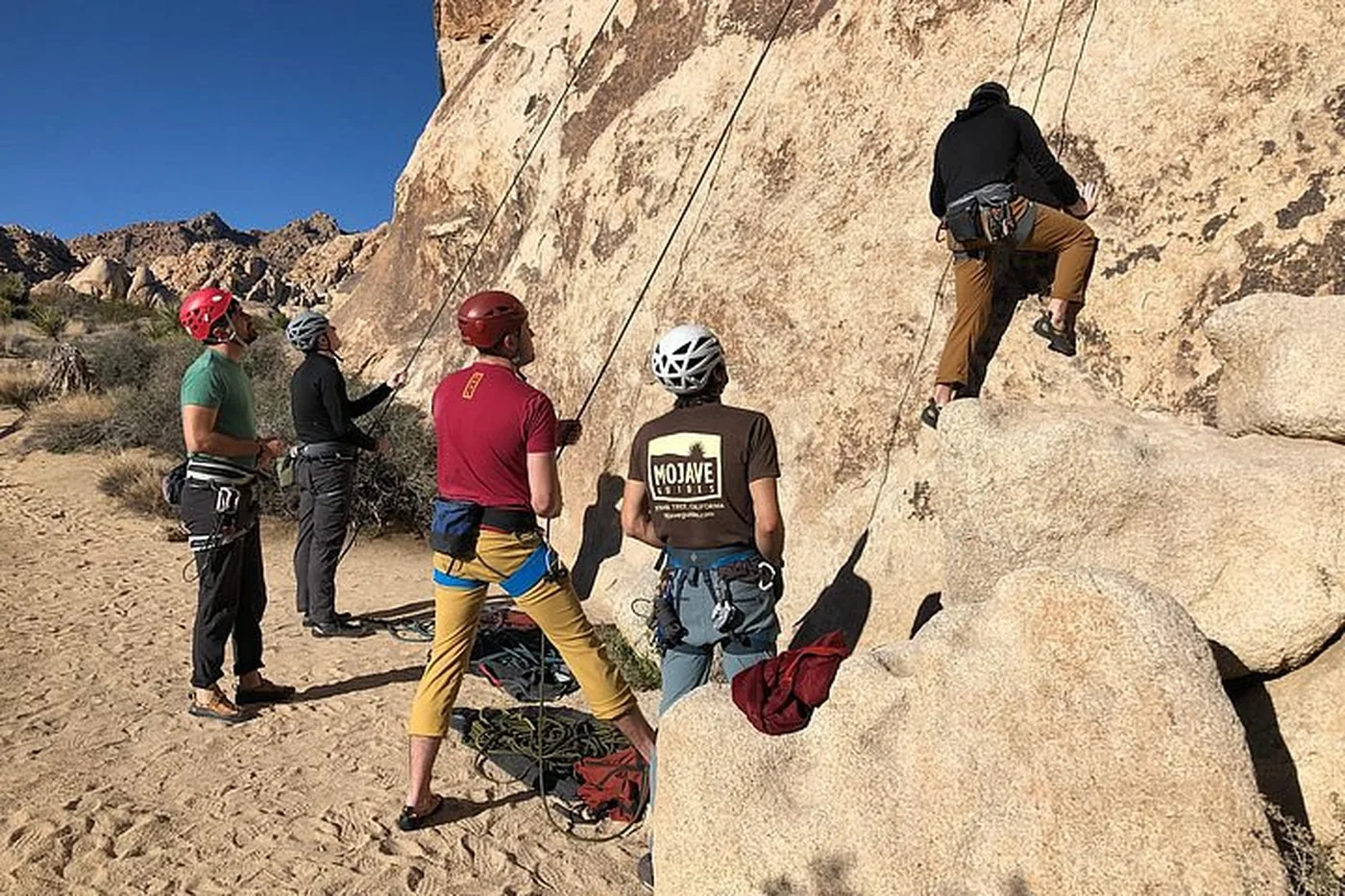
Beginner Group Rock Climbing in Joshua Tree National Park
Half-day group climbing course with Mojave Guides on the granite rocks in the park: the basics of climbing with a guide, with belay and climbing gear provided. You follow the guide in your own car from the visitor centre car park into the park; the programme ends at a different car park inside the park.
4 hours
Gear provided
Own car to the site
Park admission not included
Departure Car park of the Joshua Tree National Park visitor centre; the guide can be recognised by the uniform and a Mojave Guides magnet on the vehicle.
According to the provider, transport to the climbing site and park admission are not included. Good basic fitness required; not recommended for people with spinal injuries or heart and circulation problems. According to Viator the booking cannot be cancelled. Guide in English. Dates and prices from the provider.
View tour ↗Ad · partner link · checked 26 Sep 2026
Provider's product photo · Viator
Big Wheel Tours, Inc. · Viator
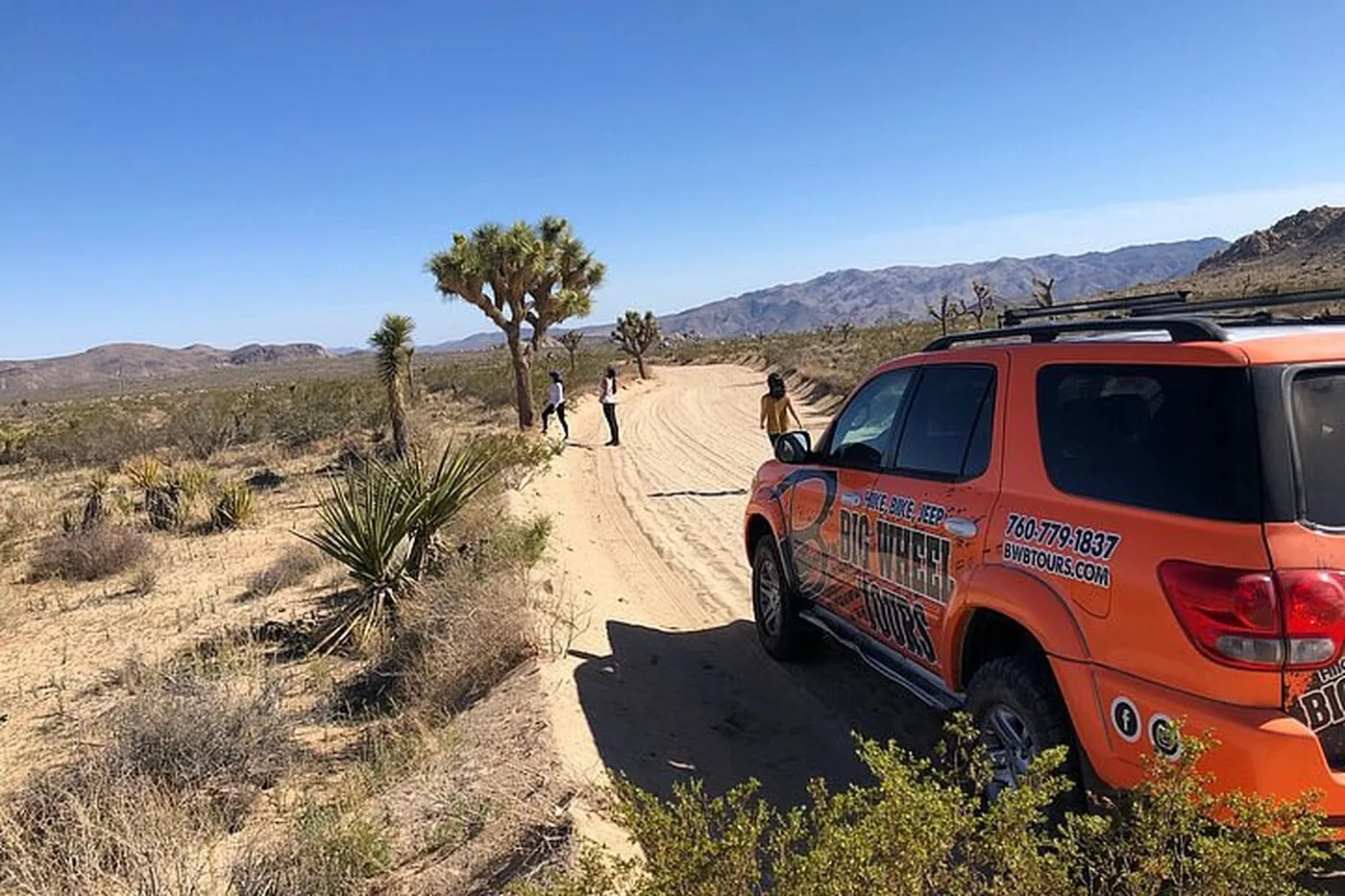
From Palm Desert: off-road tour on Geology Tour Road
Five hours with Big Wheel Tours: into the park through one of the paved main entrances, some highlights, then onto Geology Tour Road. According to the provider it is the only place in the park where all three rock formations can be seen: Pinto gneiss, White Tank monzogranite and the basalt of Malpai Hill.
5 hours
From Palm Desert
Snacks and water
Park admission not included
Departure Big Wheel Tours shop in Palm Desert; parking in front of the building, toilets available.
Not included: park admission and tips. No pets. The tour runs with two or more people; solo travellers should call ahead, according to the provider. Minimum age 6; not recommended for people with back, neck or heart problems, during pregnancy or after surgery. Commentary in English. Cancellation up to 24 hours in advance.
View tour ↗Ad · partner link · checked 26 Sep 2026
Provider's product photo · Viator
Joshua Tree park authority (National Park Service) · Ranger programme · free
Ranger evening and night-sky programmes
Joshua Tree is an International Dark Sky Park. Rangers regularly offer programmes about the night sky, plus evening programmes, for example in the amphitheatre at Jumbo Rocks Campground. If you want to watch without a programme, the park designates four car parks as stargazing spots: Quail Springs, Hidden Valley, Cap Rock and Ryan Mountain.
Free
Dates in the park's calendar
Bring warm clothes and a red light
Meeting point Changing locations in the park; the meeting point is listed with each date in the park's calendar.
According to the park authority, ranger-led walks, talks and evening programmes are free; park admission still applies. The park does not give fixed weekly times; check the events calendar or ask at the visitor centres. White light and light painting are not allowed; at the stargazing spots, stay close to your vehicle and stay alert. According to the park, further programmes are offered by its partner Sky's the Limit Observatory in Twentynine Palms, outside the park.
Park authority page ↗Park authority programme · no partner link · checked 29 Sep 2026
Joshua Tree park authority (National Park Service) · Ranger tour · Keys Ranch
Guided tour of Keys Desert Queen Ranch
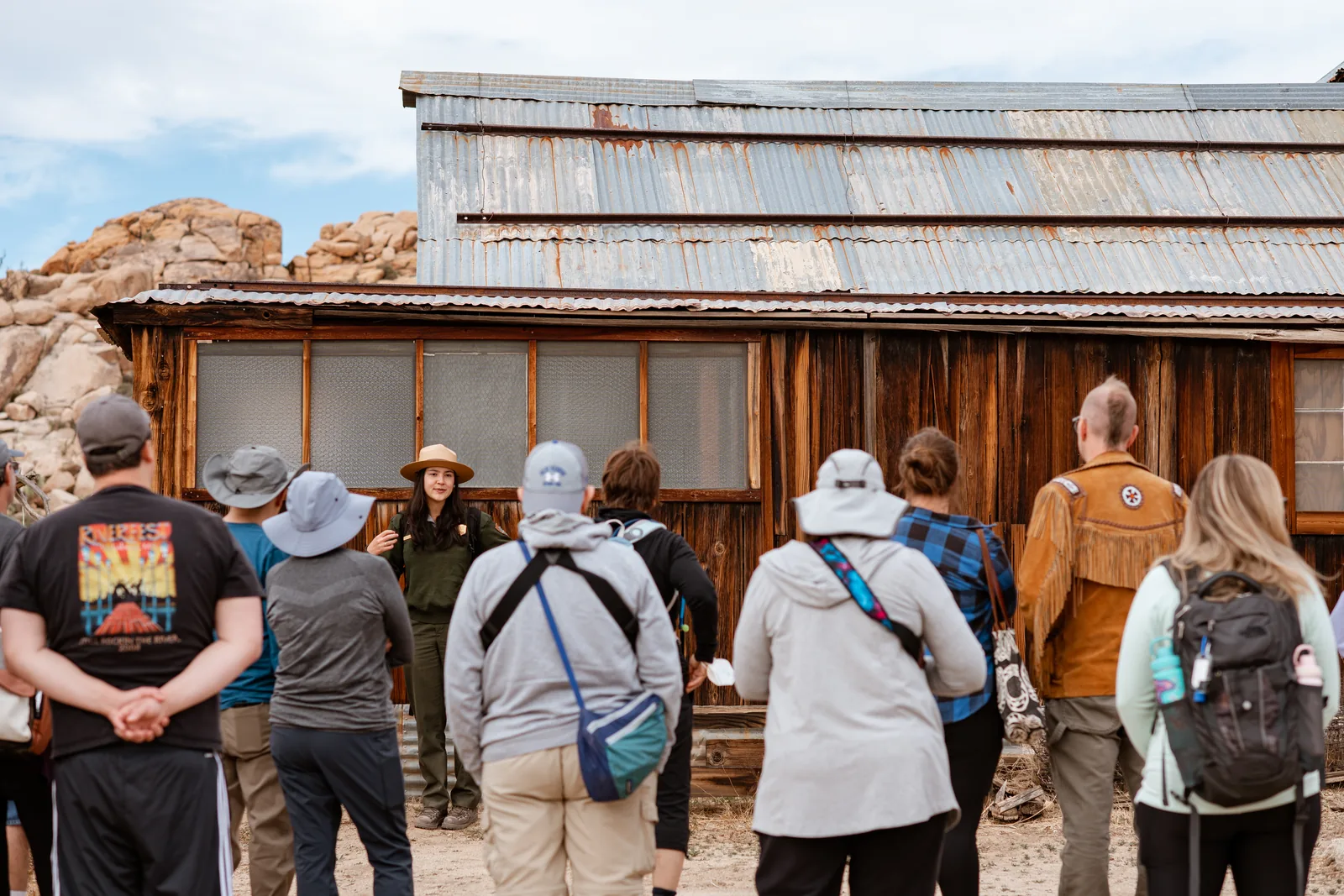
Keys Ranch, in a remote rocky canyon near Hidden Valley, can only be visited on a tour led by the park authority. Depending on the tour, topics include the history of the native peoples, mining, ranching, the Keys settler family and how the ranch became a protected site.
120 minutes, about 800 metres (0.5 mi) on foot
October to May
Reservation via Recreation.gov
Age 12 and over $20, ages 4 to 11 $10
Meeting point Locked gate of the ranch: drive past the entrance to Hidden Valley Campground, keep left at the fork, then about two miles to the gate. Be there 15 minutes early.
Fees according to the park authority: $20 aged 12 and over, $10 for ages 4 to 11, $1 under 4, $10 with a Senior or Access Pass; park admission is not included. Tickets are required and can be booked up to 60 days in advance on Recreation.gov or on +1 877 444 6777, with a maximum of 10 people per booking. No tours in the hot summer months; tours may be cancelled in bad weather. No dogs, no eating or smoking during the tour, cameras yes, tripods no.
Park authority page ↗Park authority programme · no partner link · checked 29 Sep 2026
Ad · we may earn a commission if you book through this partner link. Offer details checked 26 Sep 2026. See official ticket information.
Nature: two deserts, three ecosystems and a tree under pressure
Where the Joshua trees grow
The Colorado Desert, a western extension of the Sonoran Desert, covers the south and east of the park, with ocotillo and cholla. The Joshua tree grows only in the Mojave part, the western half. Above 1,220 m (4,000 ft), in the Little San Bernardino Mountains, California juniper and pinyon pine grow.
Herds of bighorn sheep, six species of rattlesnake and a wide variety of birds: the park lies on the Pacific Flyway and is a stopover for migrating birds. It was originally to be called "Desert Plants National Park"; it was protected in 1936 for exactly this diversity.
Between 1895 and 2016 annual rainfall fell by 39 percent and the average temperature rose by 2 °C (3.6 °F). From 2006 to 2016, 60 percent of springs with surface water dried up; for bighorn sheep and many other species these are the only water source in summer. In the Mojave Desert, bird species declined by 43 percent between the surveys of 1908–1968 and 2013–2016.
By 2099 the average annual temperature in the park could rise by 5 °C (9 °F) under high emissions. Research the park authority relies on shows almost all suitable Joshua tree habitat in the park disappearing in that case. Even with lower emissions it would be around 80 percent. At lower, warmer elevations fewer young plants already germinate and survive today.
Introduced grasses such as red brome carry fire quickly across the desert. When a stand burns, most Joshua trees do not survive and regeneration becomes difficult. In the Dome Fire in the neighbouring Mojave National Preserve an estimated 1.3 million Joshua trees died in 2020.
What you see hanging over the valley from Keys View is mostly smog blown into the park from outside. The park authority explicitly names air quality and visibility as impaired; heat makes visibility worse still, because smog reacts differently in high temperatures.
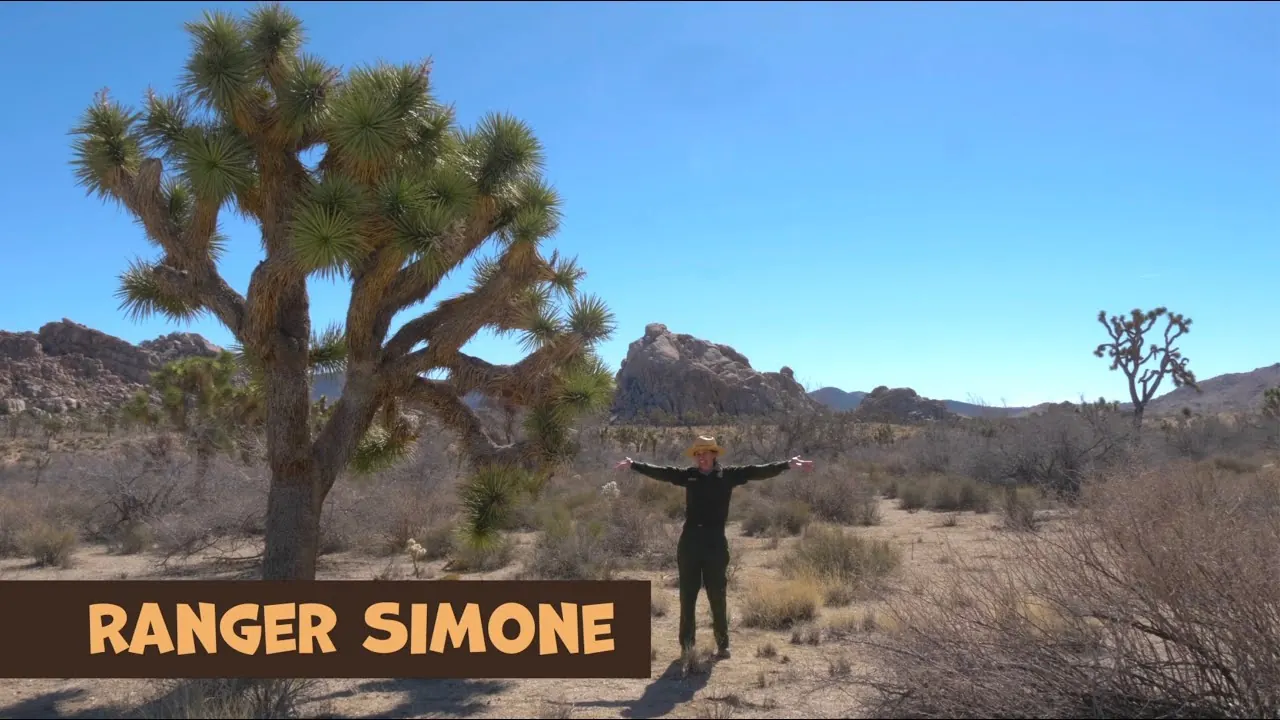
Four and a half minutes from the park authority's own channel: two rangers explain where the Joshua tree grows, why it occurs only in the Mojave Desert and how it survives in this environment. In English, with an audio-described version on the same channel.
Just under an hour from the south-west of the park, with the nearest airport. The Palm Springs Aerial Tramway climbs from the desert floor to the high country of Mount San Jacinto, the same mountain you see from Keys View.
Nothing saved yet. Every place card has a pin, and so does every place on the Map. What you save collects here, with days, notes and a preview you can share.
Reality check
Share
The plan is stored in the link itself. Anyone who opens it sees the preview and can use the plan.
Image for your phone, with stops and map.
01Best time to visit: October to May, summer is not a travel window
In July even the nights stay warmer than many a summer's day elsewhere.
Spring and autumn
The most pleasant time: highs around 29 °C (84 °F), lows around 10 °C (50 °F), humidity mostly below 25 percent. It is busiest between mid-February and mid-May.
Above 38 °C (100 °F) by day, barely below 24 °C (75 °F) at night. Air quality is much worse in summer than in winter; above an air quality index of 100, the park advises you to cut back on outdoor activity.
The trail to Fortynine Palms Oasis is closed so that bighorn sheep can reach the water undisturbed. White Tank and Belle campgrounds close; Hidden Valley stays open. A fire ban applies from 15 June to 1 October, and the Black Rock Nature Center only opens Thursday to Sunday.
From September to May the campgrounds are full almost every weekend, the first-come, first-served sites usually by Friday afternoon. Come midweek and you will notice you have much more of the park to yourself.
Best months by the climate data: February to April and October and November. Average daytime highs of 17 to 27 °C, lows of 4 to 13 °C, 6 to 23 mm of precipitation a month. The hottest month is July, with average highs of 38 °C.
0°10°20°30°40°
Jan163
Feb174
Mar216
Apr248
May2912
Jun3618
Jul3822
Aug3722
Sep3419
Oct2713
Nov207
Dec153
High °CLow °C
Daily highDaily lowPrecipitation
All monthly values as a table
Monthly averages 2001–2020, NASA POWER model
Month
High °C
Low °C
Precipitation mm
January
15.5
3.2
23
February
16.8
3.6
23
March
20.8
6.1
10
April
24.3
8.2
6
May
29.4
12.4
2
June
35.5
17.5
0
July
37.8
22.2
9
August
37.2
22.0
8
September
33.7
18.6
6
October
27.1
12.6
8
November
20.4
7.4
10
December
14.7
2.9
22
Year
127
Modelled values, not a weather station: NASA POWER (MERRA-2) for a grid cell of about 55 × 60 km around the map point Barker Dam (34.03° N, 116.15° W), with an average cell elevation of about 920 m. Averages for 2001–2020. Higher ground and valleys can differ markedly.
02How to get there: three entrances, two approach roads
From Interstate 10 or from Highway 62: your choice decides what you see first.
West entrance near Joshua Tree
Eight kilometres (5 mi) south of the junction of Highway 62 and Park Boulevard in the town of Joshua Tree. The shortest way to Hidden Valley, Keys View and Ryan Mountain, and therefore the busiest entrance.
Five kilometres (3 mi) south of the junction of Highway 62 and Utah Trail. Usually quieter than the west entrance and closer to the main visitor centre.
At Cottonwood Spring, 40 km (25 mi) east of Indio. There is no staffed fee booth here; you pay at the Cottonwood Visitor Center. If you come from Phoenix or the Salton Sea, you enter here and first cross the Colorado Desert before the Joshua trees begin.
The nearest airport is in Palm Springs. According to the park authority, public transport to the park is limited; the Morongo Basin Transit Authority has the timetables. There is no shuttle inside the park.
The park authority warns explicitly: navigation systems send vehicles onto rutted or deep-sand tracks that normal cars cannot pass. Inside the park the same goes for hiking apps; more on that under hikes.
Parking at Hidden Valley, Barker Dam and Keys View: before 9 a.m.
According to the park, popular parking lots may temporarily close once they are full: Hidden Valley, Barker Dam, Keys View, Split Rock and Lost Horse Mine. Rangers advise arriving before 8 a.m. and visiting these sites before 9 a.m. If a lot is full, move on to a different area and choose your hike based on where you find parking.
Use marked parking spots or graded shoulders along the road, never red curbs, campgrounds or soil and vegetation. Driving off-road can lead to a citation of up to $180. Parking is tightest on weekends and holidays from October to May and during spring break from March to mid-April.
Outdoor Adventures, Inc. · Sightseeing tour · from Palm Springs, Palm Desert or Yucca Valley
From Palm Springs, Palm Desert or Yucca Valley: sightseeing tour of the park
Small-group tour by minibus with a guide who explains the geology and the history of the Serrano people and the settlers. In the park: rock formations with an optional guided walk, a climbing rock, an optional path to rock art and an old cowboy dam, and finally Keys View with a view as far as the Salton Sea.
Departure Palm Desert, Palm Springs Art Museum (main entrance) or Yucca Valley Welcome Center, the one closest to the park.
Contradiction disclosed: Viator's list of services shows 'general admission' as included, but the description and the redemption note say park admission is not included; every guest should buy a pedestrian pass on Recreation.gov in advance or bring an annual pass. Check with the provider before booking. According to the park authority, admission without your own vehicle is $15 per person aged 16 and over. The tour only runs with four or more people, otherwise an alternative or a refund is offered. Viator's web address mentions a Hummer H2, the title a minibus tour; the gallery shows both. Commentary in English. Cancellation up to 24 hours in advance.
View tour ↗Ad · partner link · checked 29 Sep 2026
Ad · we may earn a commission if you book through this partner link. Offer details checked 29 Sep 2026. See official ticket information.
03Tickets & entrance fees: $30 per car, no non-resident surcharge
The $100 surcharge introduced in 2026 applies at eleven parks. Joshua Tree is not one of them.
A private vehicle with everyone in it costs $30 and is valid for seven days. A motorcycle costs $25; if you come on foot or by bike and are aged 16 or over, you pay $15. Children under 16 pay nothing.
Since 2026, people aged 16 or over without US residence pay an extra $100 at eleven parks: Acadia, Bryce Canyon, Everglades, Glacier, Grand Canyon, Grand Teton, Rocky Mountain, Sequoia & Kings Canyon, Yellowstone, Yosemite and Zion. Joshua Tree is not on that list. Two adults in a hire car therefore pay $30 here, not $230.
The non-resident America the Beautiful Pass costs $250 and covers entry and surcharge for the whole vehicle. For Joshua Tree alone it makes no sense. As soon as a surcharge park is added, though, the sums change: Joshua Tree plus Grand Canyon cost two adults $265 when paid separately, more than the pass.
An America the Beautiful Pass bought before 1 January 2026 is valid for twelve months from purchase on its original terms and covers entry and surcharge for the holder and everyone travelling in the private vehicle.
The park's own annual pass is not for international visitors
The Joshua Tree Annual Pass at $55 is valid for twelve months for one vehicle, but according to the park authority it is only available to US citizens and US residents.
At the west and north entrance stations you can pay by card only; the visitor centres also take cash. Since 2026 the Park Service's fee-free days apply only to US citizens and US residents.
04Where to stay: nine campgrounds and no hotel in the park
If you are not camping, you sleep outside the park.
With a reservation
Black Rock (99 sites, $35) and Cottonwood (62 sites, $35) have water, flush toilets and a dump station. Indian Cove (101 sites, $35), Jumbo Rocks (124 sites, $30) and Ryan (31 sites, $30) have pit toilets, tables and fire rings, but no water. Reservations through recreation.gov, up to six months in advance.
Hidden Valley (44 sites), Belle (18) and White Tank (15) cost $25 and are first-come, first-served: find a site, claim it, then pay at an entrance station within one hour. From September to May they are full almost every weekend.
Staying overnight at the roadside or in pull-outs is prohibited and enforced. If you cannot find a site, go to BLM land outside the park, to private campgrounds or to the nearby towns.
Group sites for 10 to 60 people are available at Cottonwood, Indian Cove and Sheep Pass (from $55). Cottonwood and Sheep Pass are tent-only. Black Rock and Ryan have their own horse camps, bookable only if you bring a horse.
Hammocks, slacklines and other horizontal lines may not be attached to vegetation, including Joshua trees and junipers, only to rocks and climbing bolts. In campgrounds they are not allowed at all.
The desert does not forgive poor preparation, and not always good preparation either.
Four litres of water per person
For a summer day the park authority recommends four litres (1 US gallon) per person, plus water for cooling off. There is none inside the park. Bottle filling stations are at the Black Rock Nature Center, the West Entrance Station and the main visitor centre; you can also fill containers at the Indian Cove Ranger Station, at Black Rock and Cottonwood campgrounds and at park headquarters.
That is the park's explicit recommendation. Also: salty snacks against salt loss, rest in the shade, drink before you get thirsty. A torch belongs on a day hike too, so that you can walk back in the cool evening air.
The hiking page tells the story of Paul Miller, an experienced hiker and photographer from Ontario. On 13 July 2018 he set out on the 4.8 km (3 mi) Fortynine Palms hike and did not return; he was only found in December 2019, away from the trail. The park tells the story as a reminder of the simplest rule: tell someone where you are going and when you plan to be back, and check in afterwards.
Dogs must be on a lead and are not allowed on trails or in the backcountry. The exception is the loop at the Oasis of Mara by the visitor centre. In summer the park advises not to bring dogs at all, and never to leave them in a car or tied up.
06Frequently asked questions: Joshua Tree National Park
How much is the entrance fee for international visitors?
A private vehicle with everyone in it costs $30 for seven days, the same for international visitors as for US citizens. Joshua Tree does not charge the $100 surcharge for visitors without US residence; it applies only at eleven other parks, including Grand Canyon, Yosemite, Zion and Sequoia.
Do I need a timed-entry reservation for Joshua Tree?
No. Joshua Tree has no timed-entry system and no entry reservation. The park is open 24 hours a day, all year. You only need to book for campgrounds and for the guided tour of Keys Ranch.
October to May. In spring and autumn highs are around 29 °C (84 °F), in winter around 15 °C (59 °F) with frosty nights. In summer it gets hotter than 38 °C (100 °F) and barely cooler than 24 °C (75 °F) at night; several trails and campgrounds are then closed. It is busiest between mid-February and mid-May.
No. Inside the park there is no drinking water, no fuel and no shop. Water for refilling is only available on the edge: at the Black Rock Nature Center, the West Entrance Station and the main visitor centre in Twentynine Palms. For a summer day the park recommends four litres (1 US gallon) per person.
Can you stay overnight in Joshua Tree National Park?
Only at one of the nine campgrounds. There is no hotel or lodge in the park. Five campgrounds are reserved through recreation.gov, three are first-come, first-served and one is a group campground. Sleeping in your car at the roadside is prohibited. Accommodation is available in Joshua Tree, Twentynine Palms, Yucca Valley and Palm Springs.
One day is enough for the core route along Park Boulevard: Hidden Valley, Barker Dam, Keys View, Skull Rock. Two days also allow for Ryan Mountain, the Cholla Cactus Garden on Pinto Basin Road and a night under the stars, which is what the park is really famous for.
Only in the western half of the park. The tree grows exclusively in the Mojave Desert; the south and east belong to the Colorado Desert with ocotillo and cholla. If you enter through the south entrance on Interstate 10, you only see the first Joshua trees after about an hour's drive.
No. The park authority states clearly that there is no mobile network in the park. Download or print digital tickets and maps before you set off, and tell someone where you are going and when you plan to be back.
Which 11 national parks charge a $100 non-resident fee?
Acadia, Bryce Canyon, Everglades, Glacier, Grand Canyon, Grand Teton, Rocky Mountain, Sequoia & Kings Canyon, Yellowstone, Yosemite and Zion. Since 2026, people aged 16 or over without US residence pay an extra $100 there. Joshua Tree is not on the list.
Is the America the Beautiful Pass worth it for Joshua Tree?
Not for Joshua Tree alone: the non-resident pass costs $250, while a car here costs $30 for seven days. It pays off once a surcharge park is added: two adults pay $265 for Joshua Tree and Grand Canyon separately, more than the pass.
Researched 22 Sep 2026. Not a live status. Dates apply only to the year stated. A successful automatic fetch is not an editorial confirmation; outdated automatic values are hidden and replaced by the source link.